 English
  Français
 Español


Moonstone is « [the] only one with a glow whose intriguing azure whiteness and excessive brilliance can only be compared to the dazzling effect of the full moon. » wrote, around 1825, Antoine Caire-Morand, the renowned lapidary, in his work devoted to precious stones.
Once designated by various names : lunar stone, fish eye, specular stone, argentine, it is today classified among the orthoclases under the name adularia. A rather austere label for this beauty of mother-of-pearl and silver, which is why the delicate name « moonstone » is preferred.
Mineralogical characteristics of moonstone
Moonstone is a mineral of the silicate class, the tectosilicate subclass and the feldspar group. There are two families of feldspar :
- alkali feldspars (potassium) : orthoclase, microcline, sanidine…
- calcium-sodium feldspars called plagioclases : oligoclase, albite, labradorite…
The name « moonstone » is usually given to a certain variety of orthoclase (or orthose) displaying a white, blue or silvery iridescence : adularia. However, other feldspars with the same appearance can also be moonstones, e.g. white labradorite, sanidine, oligoclase, albite…
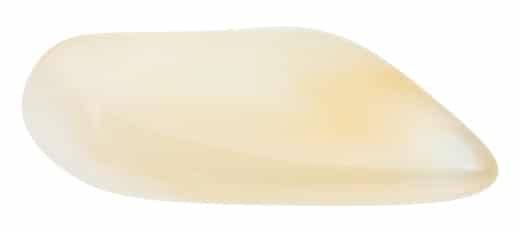
Adularia originally comes from the Swiss Alps. All orthoclases displaying the characteristics of this variety may today bear this name, wherever they come from. It is found in granites, pegmatites, hydrothermal veins, and in acidic and alkaline igneous rocks.
Fine, large specimens are very rare. The most prized adularias are colorless or white with blue or grey-blue reflections. Those with yellowish reflections are less sought after. Adularia has perfect cleavage, it is transparent to translucent with a vitreous or silky lustre. Fairly hard, 6/6.5 on a scale of 10, it proves brittle and fragile.
Moonstone jewellery and objects
-
-
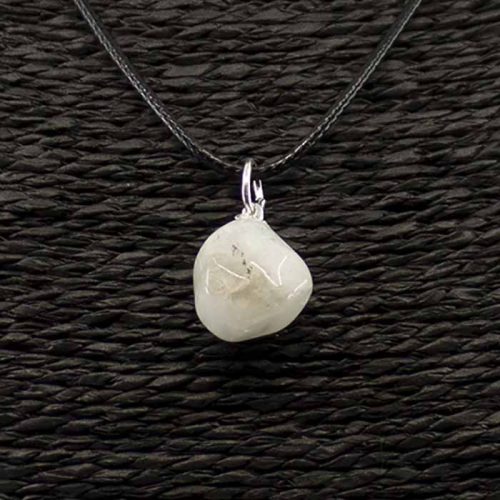
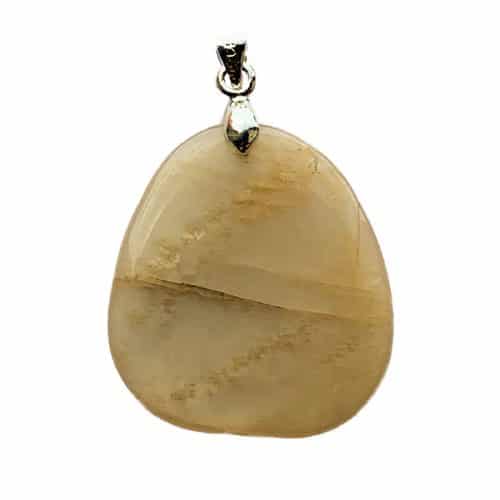
 Select options This product has multiple variants. The options may be chosen on the product pageQuick ViewPierre de Lune, Pierres Plates
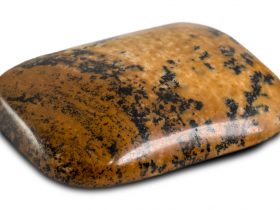
Pierre de Lune Rousse – Pierre Plate
Price range: 12,60€ through 19,80€ -
-

Adularescence
This is the name given to the iridescence phenomenon specific to adularia but also to other similar stones. Adularescence comes from the reflection of light between the myriad thin lamellae developed during the crystallization phase.
This particular shimmer produces silvery reflections that seem to float on the surface of the stone. This characteristic is also called the « Schiller effect ». Adularescence is revealed by a cabochon cut, the pearly undulations then moving gracefully under a light source. The adularescent effect disappears at a temperature above 750°.

Albite lamellae can produce distinctly milky shades. Some stones, extremely rare, display a star effect (asterism) due to tiny inclusions of rutile or ilmenite. Exceptional moonstones can be admired at the Smithsonian Institution in Washington.
Mining sites and deposits
The finest moonstones are mined in the south-west of Sri Lanka. It is also found in the following countries and places:
- India (Tamil Nadu), where sanidine is common, generally more coloured and satin-like in appearance
- Burma
- Madagascar (Itrongahy), for yellow orthoclase or sanidine
- Tanzania
- Canada (Mont Saint-Hilaire)
- Brazil
- Mexico, where sanidine or adularia known as valencianite is found
- United States (State of New Mexico)
- Russia (White Sea)
- Australia
- Austria (Tyrol), Switzerland (Saint-Gotthard)
- France (Cantal, Haute-Vienne, Hérault, Lozère, Puy de Dôme)
Confusions and deceptions
Confusions are possible with:
- girasol quartz
- white chalcedony
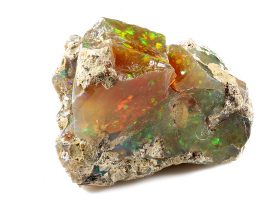
- opal
- selenite.
Rainbow moonstone, Norwegian moonstone and spectrolite are labradorites. The designation « Californian moonstone », meanwhile, is prohibited since it actually refers to a chalcedony.
Fake moonstones exist. The doublet technique and the coloured coating of stones then called « celestial moonstones » are deceptive practices intended to artificially intensify the colours and reflections. Attempts are made to imitate moonstone by heating colorless synthetic spinels to obtain a milky appearance.
Are there « moonstones » on the moon ?
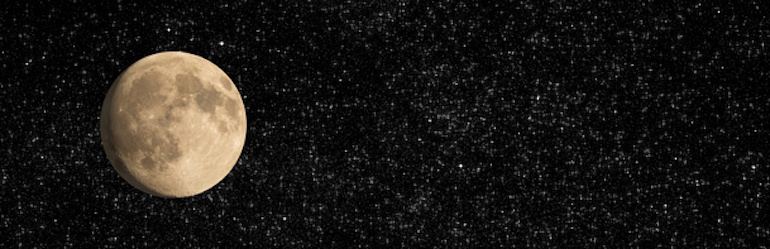
Minerals of the same family are present there in large numbers : plagioclase feldspars (sodium-calcium) in particular, while potassium feldspars are rarer. The astronauts brought back over 300 kg of lunar minerals. At the Space Center in Cape Canaveral, Florida, visitors can touch a genuine moonstone. In France, one can be seen at the Cité de l’Espace in Toulouse, weighing 2 kg. The appearance of these specimens is not very appealing and in no way evokes the resplendent celestial body they come from, unlike terrestrial moonstones.
Etymology and meaning
In 1801, René-Just Haüy proposed the name orthose to designate the mineral of which moonstone is a variety. From the Greek orthos meaning « straight », this term evokes the right-angled cleavage of this mineral. The internationally accepted term is orthoclase.
At the same period, the French mineralogist Jean-Claude Delamétherie gave the name hecatolite to the pearly feldspar, drawing inspiration from the Greek goddess of the moon, Hecate.
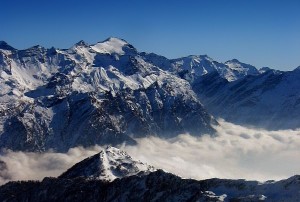
Hecatolite quickly gave way to the name adularia in reference to the place of its discovery. Adularia comes from Mount Adule or Adula in the Saint-Gotthard massif (Swiss Alps). The Greek geographer Strabo, born in 64 BC, was the first to name this place in his books. A century later, another Greek scholar, Ptolemy, thought and wrote that the Rhine had its source “in Adula Monte”.
Moonstone through history
Moonstones in Antiquity
We have several descriptions that may correspond to our current moonstones. These stones certainly came from the East or even from the Alps :
- Argyrodamas: a silver-coloured stone.
- Asteria: it holds enclosed a certain mobile light like pupils.
- Astrion: white, at the centre it shines like a star whose light resembles that of the moon.
- Astrobolos: resembling fish eyes. Exposed to the sun, it casts white rays.
- Astroites: also white, with magical virtues used by Zoroaster.
- Ceraunia: crystalline with blue reflections, it absorbs the light of the celestial bodies. Sought after by the magi, it is found only in places where lightning strikes.
Finally, there is selenite or selinitis (Dioscorides’ name evoking the moon goddess Selene): whitish, transparent, whose lustre can have the colour of honey. It renders, like a mirror, the figure of the moon according to whether it is waxing or waning. Today, selenite is a mineral classified among the gypsums, but in Antiquity and up to the Middle Ages, this name seems to have referred mainly to a moonstone with magical powers.
The biography of Pythagoras, written by the Greek philosopher Iamblichus around 300 BC, tells us that he is said to have travelled to Chaldea, land of the magi and of Zoroaster. He attends the great lunar festivals of Orchoe :
« Happy Chaldea ! I can tell you that the same lunar ceremonies of Egypt have far less solemnity. I observed that the participants held in their hands a fragment of selenite while repeating the hymn to the moon : O moon, you are the queen of the stars and the mother of astronomy … »
These facts coincide with the archaeological discoveries concerning the ancient city of Orchoe in the land of Basra. It is probably the present-day city of Warka. Orchoe could mean « lunar city »; there the fertility goddess Ishtar was worshipped, daughter of the moon god Sin and of the goddess Ningal embodying the femininity of the moon.
A work of magic, The Cyranides, written in Greek from the 1st century onwards, also speaks to us of selenite:
This white and shining stone is given to epileptics in the form of shavings in a drink. Women use it as amulets in place of phylacteries. Placed at the foot of trees, it makes them bear fruit. Place some parsley root in a gold capsule which you will attach beneath the stone, and then wear this strap around your neck. This gives divine inspiration; indeed many kings wear one beneath their garments !
Generally speaking, in antiquity, the moon and everything connected to it is associated with woman and fertility, probably because of the similarity between lunar cycles and menstrual cycles. In Egypt, another aspect is clearly associated with moonstone : the protection of nocturnal journeys. Thoth and Khonsu are the lunar gods, navigators of the night.
Moonstone in the Sinhalese kingdom
Sri Lanka of former times is the Sinhalese kingdom. Moonstone is called Shandra Kanti, which could be translated as « the feminine beauty of the moon » (Shandra or Chandra being the lunar deity). These pearly stones, one of the riches of the island, are certainly pieces of moonbeams. Their beneficial and magical effect favours the monsoon. Women have always sewn moonstones into their clothes in order to have children; this rite is in fact found in all civilizations.

The moonstones of Sri Lanka also refer to very ancient ornamental friezes of sandstone or granite decorating the entrances of Buddhist temples and palaces as a sign of welcome. Most often composed of animals (elephants, horses…), these sculptures have the symbolic form of a half-moon, hence their name. They have no connection with the moonstone mined from deposits. At Ambalangoda, lit by candles, the miners advance through narrow galleries saturated with humidity, shored up with palm wood. The conditions for mining moonstones are the same today.
Moonstone in the Middle Ages
Marbode, a 12th-century bishop, revisits the powers of selenite (which, it was said in the 19th century, would be adularia) : “It marks the phases of the moon, grows with its birth, wanes with its decline“. In the 14th century, John of Mandeville also recalls its other powers in lithotherapy: « The moonstone gently guides those who travel by sea and protects them from storms and from the perils of thieves. It watches over pregnant women and helps them to deliver in due time. »
In the Renaissance
The Roman lord Marc-Antonio Colonna was a cardinal archbishop, librarian of the Vatican in the 16th century. He assures us, in his memoirs, that Pope Leo X, son of Lorenzo de’ Medici the Magnificent, had a selenite on which a white spot grew and shrank at the same time as the moon. One of his successors, his Medici cousin Pope Clement VII, possessed a heliolite with a spot of gold that marked the rising and setting of the sun.
Later, in 1734, « Le Journal des Sçavants », the first French periodical, deemed these claims completely far-fetched and that was the end of the stone that changes appearance at the same time as the moon !
Moonstone in the modern era
As always in that period, many scholars examined moonstone in order to identify it, name it and classify it definitively, after many analyses, among the feldspars.
The pearly feldspar would be definitively renamed « adularia » after the Italian physicist Ermenegildo Pini, an ecclesiastic and professor of natural history in Milan, discovered it in 1783 in the Swiss Alps. He is said to have asked an Italian artist to engrave in intaglio a depiction of Achilles on an adularia, and the result was said to be admirable.
The geologist Dolomieu, who gave his name to the Italian Alps, the “Dolomites”, possessed a moonstone as large as a small apple. He is said to have picked it up in very ancient Roman ruins. Late-18th-century scientists wondered where this antique and genuine feldspar with its remarkable cleavage came from.
Two kinds of adularia were then distinguished :
- The western adularias of Saint-Gotthard, often small but of incomparable lustre. They often display a small defect : oblique striations that cross the stone.
- The eastern adularias from Ceylon. In larger pieces, slightly duller but homogeneous.
The adularia of the mineralogists gives way to the moonstone of jewellery with the advent of Art Nouveau at the end of the 19th century.
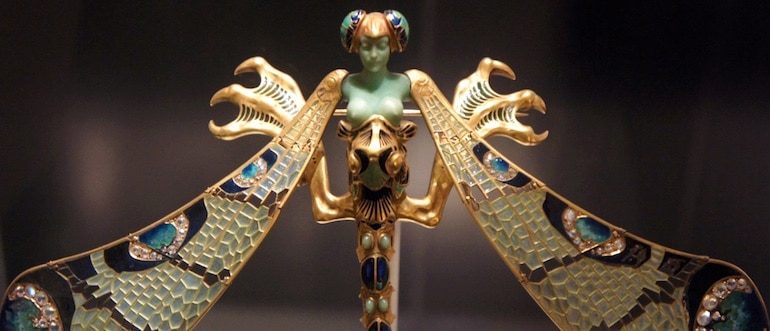
Nature becomes fashionable. René Lalique draws inspiration from fauna and flora and designs jewellery that would become hugely popular. He uses little-known or neglected stones, his favourite being moonstone. His somewhat strange creations, half-woman half-animal, delight the great eccentrics of the time, weary of overly classical jewellery. Sarah Bernhardt would wear the famous great dragonfly brooch, with its moonstone wings assembled like a tiny marquetry.
Virtues and benefits of moonstone in lithotherapy
Moonstone is an essentially feminine stone, a symbol of candour, of simple and tender virtues, and beneficial to the specifically feminine aspects of fertility, such as pregnancy or menstruation. It is also reputed to protect nocturnal travellers and bring determination and intuition. It is associated with all the chakras and balances Yin energy.
The benefits of moonstone against physical ailments
- Relieves menstrual and menopausal disorders
- Reduces acne
- Stimulates fertility
- Protects pregnancy and childbirth
- Promotes lactation
- Soothes insect bites
- Balances all the hormonal systems
- Improves digestive disorders related to stress
- Regulates thyroid function
- Activates the circulation of bodily fluids (draining effect)
- Calms hyperactive children
The benefits of moonstone on the psyche and relationships
- Eases new beginnings
- Fosters tender and harmonious relationships
- Softens quick-tempered and severe characters
- Induces lucid dreams, clairvoyance and premonition
- Guards against sleepwalking
- Soothes anxieties, brings serenity
- Promotes wisdom
- Develops intuition
- Stimulates creativity
- Eases the transition between the conscious and the unconscious
Cleansing and recharging moonstone
Moonstone should be cleansed and recharged frequently so that it retains its milky brilliance. Spring water, demineralized water or simply running water will suit it perfectly. Avoid salt or use it very occasionally. Expose it for a few hours to the light of the moon to recharge it.




Leave a Reply