 English
  Français
 Español

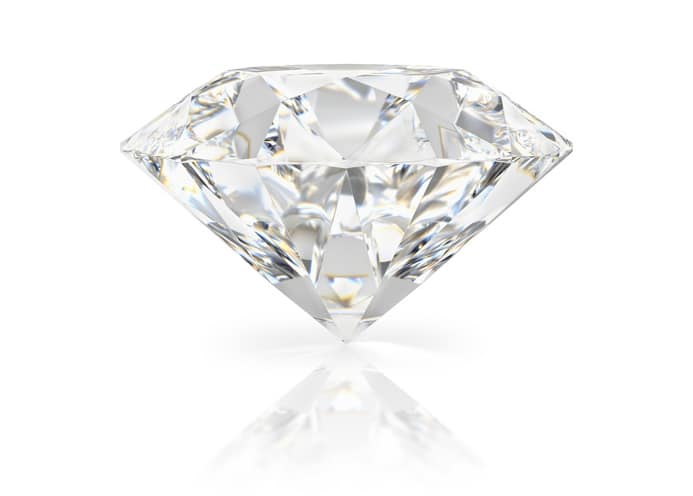
Diamonds come from a kingdom in India called Mutfili. After the rainy season, water rushing down from the mountains sweeps them into deep valleys. These hot, damp places teem with venomous snakes, and their dreadful presence guards the fabulous treasure. Greedy men throw chunks of meat onto the ground, the diamonds stick to them, and white eagles swoop down on the bait. The great birds of prey are caught and killed, and the meat, diamonds and all, is pried from their talons or pulled out of their stomachs.
Marco Polo reports this curious scene in the account of his travels. It is only an old legend, one that existed long before him, but it bears witness to age-old alluvial mining at Golconda, ancient kingdom of the mysterious Indies…
Mineralogical characteristics of diamond
Diamond is a native element, like gold or silver. A single element goes into its formation: carbon. It is classed among the native non-metals along with graphite (also made of carbon, but with a different structure) and sulfur.
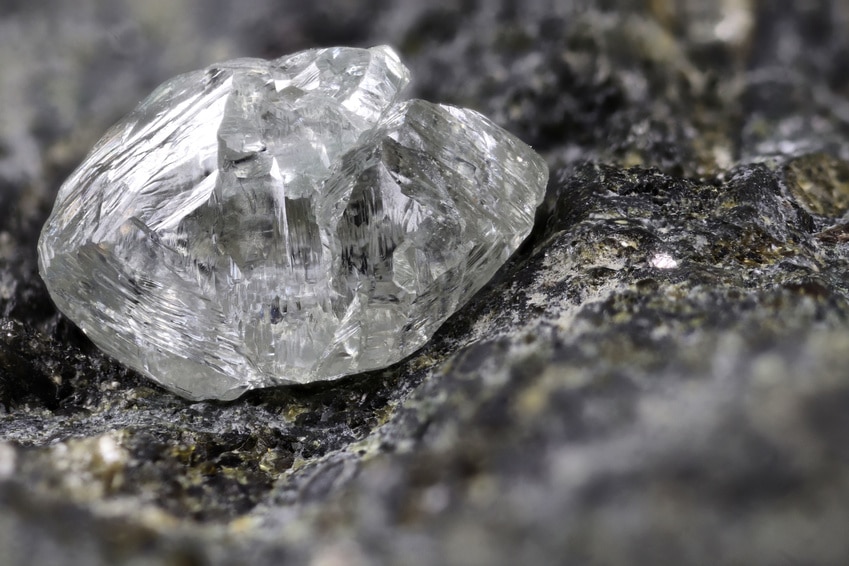
It is found in rock and in alluvial sands. Its rock sources are lamproite and, above all, kimberlite. This rare volcanic rock, also known as “blue ground,” formed at the very end of the Cretaceous. It takes its name from the town of Kimberley in South Africa. Very rich in mica and chromium, it can also contain garnets and serpentines, among other minerals.
Diamonds form in the Earth’s upper mantle at tremendous depths, at least 150 km down. They stay there for millions of years before being violently ejected through the chimneys, called pipes or diatremes, of formidable kimberlite volcanoes. The last lightning-fast eruptions of this kind date back 60 million years.
Diamonds found in alluvial deposits are carried by water over considerable distances, unaltered thanks to their hardness. They turn up at river mouths and on the sea floor.
Slow, steady growth of the carbon atoms favors well-formed crystals, most often octahedral (the central atom plus 6 others at the points form 8 faces). Forms with 8 or 12 points are sometimes found. There are also irregular forms, known as granular, and the exceptional large crystals of more than 300 carats are almost always of this type. Most diamonds do not exceed 10 carats.
Hardness and brittleness of diamond
Diamond is the hardest mineral found on Earth. The German mineralogist Friedrich Mohs took it as his reference when he drew up his scale of mineral hardness in 1812. He ranked it 10th out of 10. A diamond scratches glass and quartz, but only another diamond can scratch it.
Diamond is hard, yet naturally brittle. Its cleavage, that is, the way the layers of its molecules are arranged, is regular. It favors a clean break along certain angles. The cutter, or more precisely the cleaver, observes this phenomenon and puts it to use. Sometimes the volcanic eruption that gave birth to the diamond violently splits it along a smooth plane, producing a natural cleavage.
Cutting diamonds
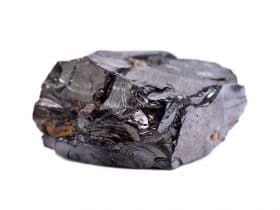
Diamonds with natural facets are said to have “naive points,” and rough diamonds with a polished look are called “ingénus” (ingenuous ones).
A diamond usually comes coated in a grayish crust often called “cascalho” (Portuguese for gravel). Once this outer skin is removed, cutting reveals the full clarity and brilliance of the stone. It is a delicate art and a labor of patience. The diamond cutter must often choose between a simple cut that preserves the weight of the rough diamond and a highly elaborate cut that may take away two-thirds of the original stone.
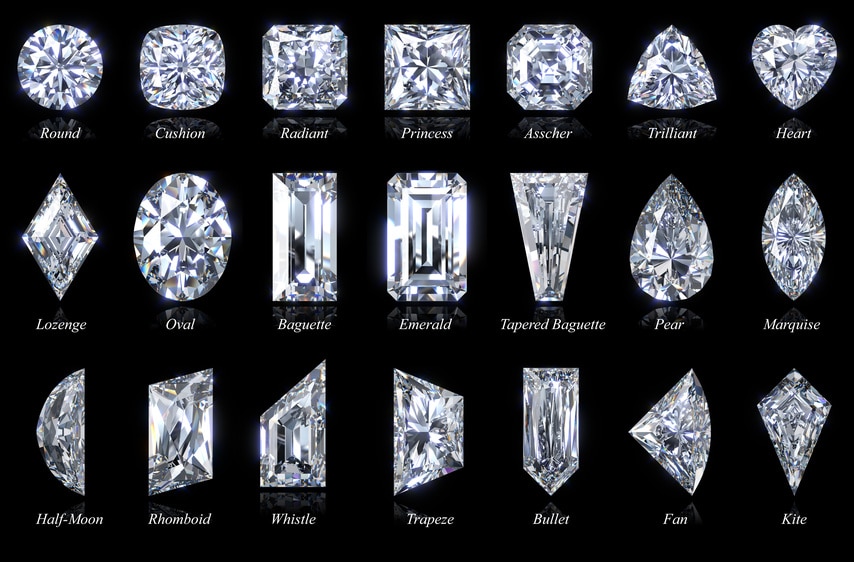
There are a great many cut shapes, each named and codified. The most prized cut today is the “round brilliant,” in which light plays wonderfully across the diamond’s 57 facets. It is the one at the top left of the photo above (labeled “round“).
Diamond colors
Colored diamonds are commonly called “fancy” diamonds. In the past, color was often seen as a flaw, since a diamond was supposed to be white or a very pale blue. Later, colors were accepted as long as they were “perfect and decided.” They must not detract from the diamond’s fire, its brilliance or its “water” (its limpidity). On those conditions, a natural colored diamond can be worth more than a “white” one.
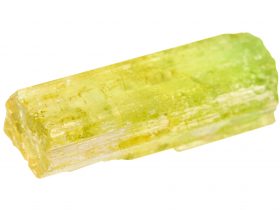
A color that is already vivid in the rough will probably yield a colored diamond of fine brilliance. Orange and purple diamonds are the rarest, and the other colors, blue, yellow, black, pink, red and green, are also sought after, with some very renowned specimens among them. The mineralogist René Just Haüy (1743-1822) called colored diamonds “the orchids of the mineral kingdom.” Back then, those flowers were far rarer than they are today!
Jewelers reject any diamond marred by tiny red spots, graphite inclusions or other flaws nicknamed “gendarmes.” Diamonds of unflattering color (yellowish, brownish), often opaque, are also weeded out. These stones, referred to as industrial diamonds, are used in industry, for cutting glass for instance.
Colors can be altered by irradiation or heat treatment. This kind of fraud is hard to detect and is frequently encountered.
Main diamond mining areas today

65% of world production comes from African countries:
- South Africa:
In 1867, diamonds were discovered on the banks of the Orange River in weathered kimberlite known as “yellow ground.” Deeper and deeper mines were then intensively worked. Today the deposits are practically exhausted.
- Angola, good quality.
- Botswana, very good quality.
- Ivory Coast, artisanal mining.
- Ghana, alluvial deposits.
- Guinea, fine crystals, often white or yellowish white.
- Lesotho, alluvial deposits, artisanal production.
- Liberia, mostly industrial-grade diamonds.
- Namibia, alluvial gravels of the Orange River, very fine quality.
- Central African Republic, alluvial deposits.
- Democratic Republic of the Congo, good quality, often yellow.
- Sierra Leone, fine crystals of good size.
- Tanzania, small crystals, sometimes colored, plus industrial crystals.
Other mining areas exist:
- Australia, the Argyle mines: a gigantic open-pit operation, pink diamonds.
- Brazil, alluvial deposits. Especially in the mining centers of Diamantino in Mato Grosso (often tinted diamonds) and Diamantina in Minas Gerais (small crystals, but of very good quality).
- Canada, expanding.
- China, very good quality, but production is still artisanal
- Russia, fine diamonds, though the cold makes production difficult.
- Venezuela, small crystals, gem and industrial quality.
Finland is the only producing country in the European Union (small quantities).
Etymology of the word “diamond”
In reference to its extreme hardness, it was named adamas, Greek for untamable, invincible. In the East it is called almas. Some ancient authors also used adamas for the magnet, hence a certain amount of confusion. The word “adamantine” describes the luster of diamond, or any luster comparable to it.
Nobody knows why diamond lost its prefix “a,” which is a privative in Greek and Latin. Take it away and you get the opposite of the original meaning, namely: tamable. It should really be an adamant, an adiamond or perhaps an indiamond.
In the Middle Ages, the French word was spelled in all sorts of ways: dyamont, diemande, diamande, diamanz, diament. Right up to the 19th century, the French plural often dropped its final “t”: des diamans. In old books, diamond is sometimes called anachite, meaning “without nightmares,” a nod to its virtues in crystal healing.
Diamond through history
Real mining begins in India (and also in Borneo) around 800 BC and continues there until the 18th century. At that time, 20 mines were counted in the kingdom of Golconda and 15 in the kingdom of Bijapur. Brazilian diamonds, the wealth of Portugal, replaced them from 1720 onward and grew so abundant that they threatened to crash the markets. Then, in 1867, came the diamonds of South Africa. In 1888, the British businessman Cecil Rhodes founded the De Beers company there, a near monopoly on the commercial mining of diamonds.
Diamond in antiquity
In his “Treatise on the Twelve Gems,” Bishop Saint Epiphanius of Salamis, born in Palestine in the 4th century AD, describes the breastplate of the High Priest Aaron mentioned in the Book of Exodus in the Old Testament: during the three great feasts of the year, Aaron enters the sanctuary wearing a diamond on his chest, “Its color resembles that of the air.” The stone changes color according to the predictions.
The British Museum in London holds a Greek bronze statuette dated to 480 BC. It depicts a richly dressed woman, her hair skillfully arranged in braids and curls. The pupils of her eyes are rough diamonds.
“Adamas is known only to a very small number of kings,” wrote Pliny the Elder in the 1st century AD. He lists six kinds of diamond, one of them no bigger than a cucumber seed. According to him, the finest diamond is Indian, and all the others come from gold mines. Those gold mines may refer to Ethiopia. That was surely no more than a stopover. Diamonds in antiquity arrived from India by way of the Red Sea.
Pliny stresses diamond’s resistance to fire and iron. Losing all sense of proportion, he suggests hammering them on an anvil to check their authenticity and soaking them in warm goat’s blood to soften them!
Because of its rarity, and its hardness too, diamond was not a fashionable jewel. Its particular qualities were used for cutting and engraving more docile stones. Set in iron, diamonds made perfect tools. The Greek, Roman and Etruscan civilizations used this technique, but the Egyptians did not know it.
Diamond in the Middle Ages
Cutting was even less advanced, and dressing up a stone was still a rudimentary affair. Rubies and emeralds held more appeal than diamond, and a simple cabochon cut was enough for those colored stones. Even so, Charlemagne fastened his imperial mantle with a clasp of rough diamond. Later, texts mention several royal figures who owned diamonds: Saint Louis, Charles V, and Agnès Sorel, the favorite of Charles VII.
Pliny’s recipe for softening it was still recommended, and even improved upon:
The goat, preferably white, must first be fed parsley or ivy. It will also drink good wine. Then things turn sour for the poor beast: it is killed, its blood and flesh are heated, and the diamond steeps in the mixture. The softening effect is only temporary, and the stone regains its hardness some time later.
There are other, less bloody methods: thrown into heated, molten lead, the diamond breaks into pieces. It can also be dipped in a mixture of olive oil and soap, from which it emerges soft and more tender than glass.
Traditional virtues of diamond
Herbalism and crystal healing held an important place in the Middle Ages. The knowledge of the Greeks and Romans was preserved, with an extra dose of magic thrown in. Bishop Marbodus in the 12th century and, later, John Mandeville tell us about the many benefits diamond brings:
It gives victory and makes its wearer mighty against enemies, above all if worn on the left side (the sinister side). It keeps the limbs and bones of the body whole. It also protects against madness, quarrels, ghosts, poisons and venoms, bad dreams and the vanities of dreaming. It destroys enchantments and spells. It cures lunatics and those the devil torments. It even drives away the demons who take the shape of men to lie with women. In short, “it delivers from all ills.”
A diamond received as a gift has more strength and virtue than a diamond bought. Four-sided ones are rarer, and therefore more expensive, but they have no more power than the others. Indeed, the virtue of diamond lies neither in its shape nor in its size, but in its very essence, in its secret nature. This teaching comes from the great sages of the land of Ymde (India), “where the waters gather and turn into crystal.”
Diamond in the Renaissance
The belief that diamond resists iron and fire died hard. So at the Battle of Morat in 1474, the Swiss took axes to the diamonds found in the tent of Charles the Bold to make sure they were real.
Around the same time, a jeweler from Liège, Louis de Berquen or Van Berckem, is said to have stumbled on a way to make them shine brighter by rubbing them against each other. Cutting techniques supposedly advanced thanks to him. The story seems hard to believe, since no trace of this man has ever been found.
The progress does date from this period, however, and probably came from the north, where the gem trade was thriving. Cutters learned to carve multiple regular facets with great delicacy: shield cuts, bevel cuts, point cuts and even the rose cut (faceted, but with a flat base, and still appreciated today).
Diamond appears more often in princely inventories. That of Agnès of Savoy, dated 1493, mentions “a ring in the shape of a clover with a large emerald, a table-cut diamond and a cabochon ruby.”
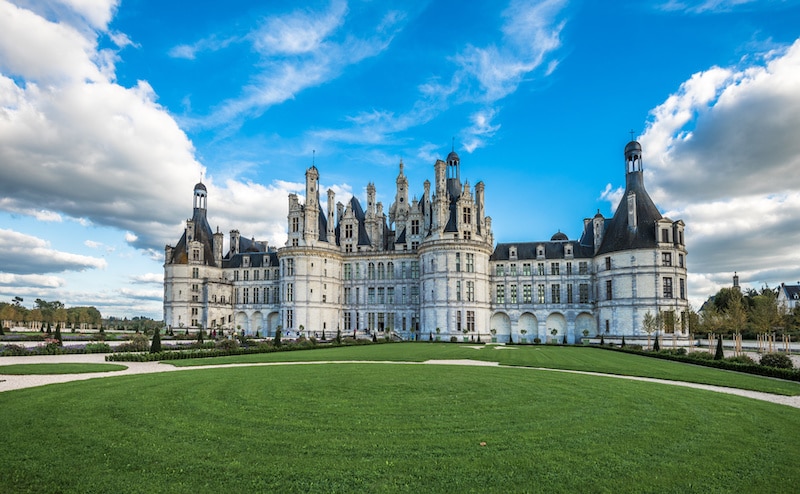
The famous anecdote in which Francis I supposedly used the diamond of his ring to scratch a few words on a windowpane at the Château de Chambord comes to us from the writer and chronicler Brantôme. He claims an old keeper of the château led him to the famous window, saying: “Here, read this. If you have never seen the handwriting of the king my master, there it is…“
Brantôme then gazed at the sharp inscription, carved in large letters:
“Souvent femme varie, malhabil qui s’y fie.” (Woman is often fickle, and foolish is he who trusts her.)
The king, cheerful by temperament, must have been in a sour mood that day!
Diamond in the 17th century
Jean-Baptiste Tavernier, born in 1605, was the son of a Protestant geographer from Antwerp. His father, persecuted in his own country, settled in Paris during a period of tolerance. Captivated since childhood by travelers’ tales and his father’s mysterious maps, he became an adventurer and a dealer in precious goods, with a particular fondness for diamonds. He may have been the first to state: “Diamond is the most precious of all stones.”
In the service of the Duke of Orléans, he traveled to the Indies six times:
Fear of danger never made me turn back, and even the frightful picture painted for me of those mines could not scare me off. So I went to the four mines and to one of the two rivers where diamonds are found, and I met with none of the difficulties or the barbarity described by a few ignorant people.
J.B. Tavernier wrote his memoirs and thus contributed greatly to knowledge of the East and of diamond. He describes a landscape full of rocks and scrub, with sandy soil, resembling the forest of Fontainebleau. He also reports some astonishing scenes:
- Workers, stripped completely naked to prevent theft, steal a few stones by swallowing them.
- Another “poor devil” pushes a 2-carat diamond into the corner of his eye.
- Children aged 10 to 15, experienced and cunning, run the middleman trade between producers and foreign buyers for their own profit.
- The Easterners appraise their diamonds by placing an oil lamp with a thick wick in a square hole in a wall, then coming back at night to inspect their stones by that light.
The final years of this tireless traveler were upended by the revocation of the Edict of Nantes. He left France in 1684 and died in Moscow a few years later.
Diamond in the 18th century
The combustibility of diamond
Isaac Newton, a solitary and touchy character, had for sole company a little dog named Diamond. Did the dog give him the idea of taking an interest in this mineral? Perhaps, since he brings it up in his treatise on optics, published in 1704: diamond might be combustible. Others had thought so well before him, such as Boetius de Boodt, author of a “History of Gems” in 1609. The Irish chemist Robert Boyle carried out the experiment in 1673: the diamond vanished under the intense heat of a furnace.
The same attempts were repeated everywhere before dumbfounded spectators. Large quantities of diamonds went into the furnace, and the exorbitant cost of these experiments did not discourage the wealthy patrons who funded them. Francis of Habsburg, husband of Empress Maria Theresa, financed trials burning diamonds and rubies together. Only the rubies survived!
In 1772, Lavoisier declared that diamond showed an analogy with charcoal, but that “it would be unreasonable to push this analogy too far.”
The English chemist Smithson Tennant proved in 1797 that diamond consumes oxygen because of its richness in carbon. Burning with the oxygen in the air, diamond turns into carbon dioxide, since carbon is the only thing in its composition.
Could the admirable diamond be nothing but luxury coal? Not quite, for it comes from the great depths of the Earth, and one can say, along with the Enlightenment mineralogist Jean-Étienne Guettard: “nature has made nothing so perfect that anything could equal it.”
Famous diamonds
Famous diamonds are very numerous, and they are often named after their owner: the diamond of the Emperor of Russia, as big as a pigeon’s egg, that of the Grand Duke of Tuscany, faintly lemon-tinted, and that of the Great Mogul, never found again, weighing 280 carats but with a small flaw. Sometimes they are known by their color and their home: the Dresden Green, of average brilliance but a beautiful deep color, and the Russian Red, bought by Tsar Paul I.
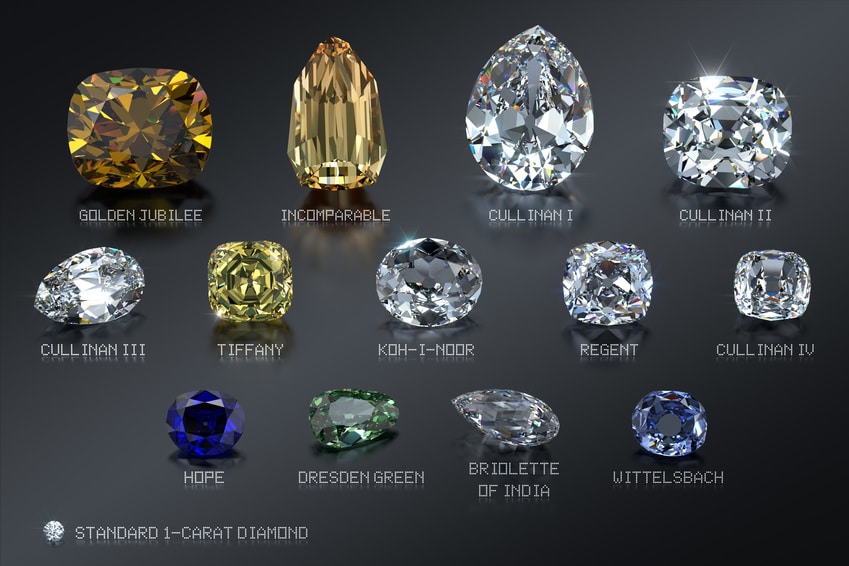
One of the best known is the Koh-i-Noor. Its name means “mountain of light.” White with gray glints, this 105-carat diamond probably comes from the Parteal mines in India. Its origin is held to be divine, since its discovery supposedly goes back to the fabled times of Krishna. Declared British property by right of conquest under the reign of Queen Victoria, it can be seen with the British Crown Jewels at the Tower of London.
Three famous diamonds from French history:
The Sancy
The Sancy, or Grand Sancy (the Beau Sancy, or Petit Sancy, is another diamond). Weighing 55.23 carats, this white diamond is of exceptional water. It comes from the East Indies.
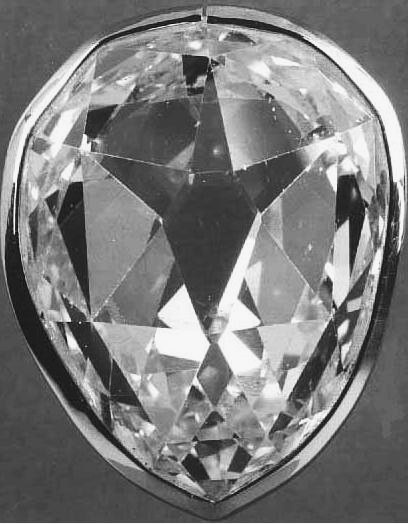
Charles the Bold is said to have been its first known owner, before it was acquired by the King of Portugal. Nicolas Harlay de Sancy, superintendent of finances to Henry IV, bought it in 1570. It was sold to James I of England in 1604, then came back to France, bought by Cardinal Mazarin, who bequeathed it to Louis XIV. It was set on the crowns of Louis XV and Louis XVI. Lost during the Revolution and recovered two years later, it was sold several times before ending up with the Astor family. The Louvre bought it back in 1976.
The French Blue
The French Blue, originally weighing 112 carats and of a deep blue, comes from the area around Golconda, India.
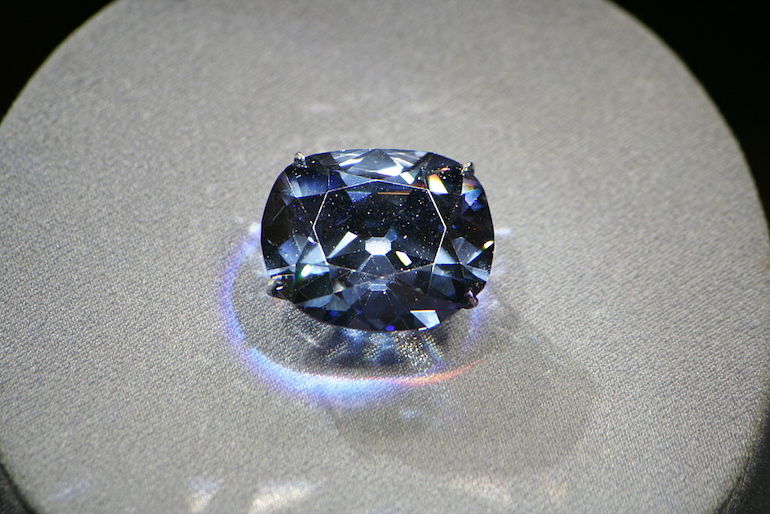
Jean-Baptiste Tavernier sold it to Louis XIV in 1668. This famous diamond went through a thousand twists and turns: thefts, losses, a string of royal and wealthy owners. It was also recut many times.
The London banker Henry Hope bought it in 1824 and gave it his name, so it enjoyed a second fame and a second life. Today it weighs “only” 45.52 carats. The Hope can now be seen at the Smithsonian Institution in Washington.
The Regent
The Regent, 426 carats rough, more than 140 carats cut, white, comes from the Parteal mines in India.
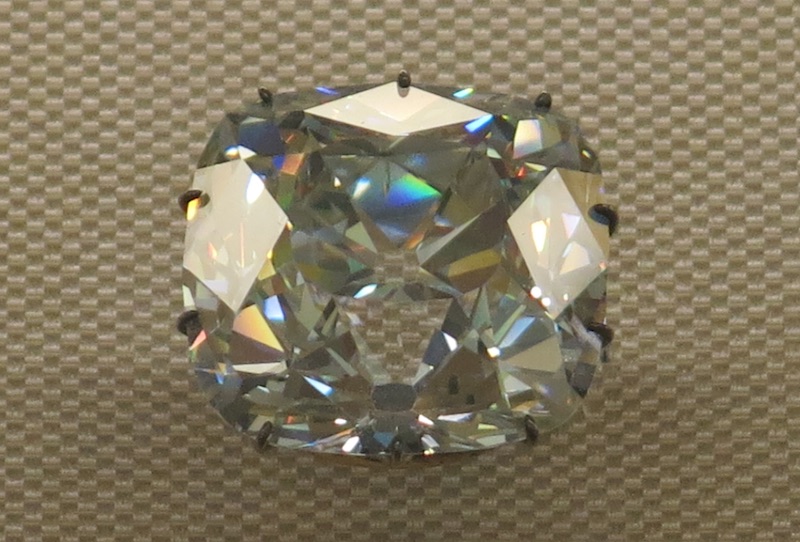
Its purity and its cut are extraordinary, and it is often considered the most beautiful diamond in the world. Its brilliant cut was carried out in England and took two years.
The regent Philippe d’Orléans bought it in 1717 for two million livres, and its value tripled within two years. It was worn first by Louis XV and then by every French sovereign down to Empress Eugénie (it was stolen and went missing for a year during the Revolution). The Regent now shines at the Louvre Museum.
Diamond jewelry can also achieve great fame, through its beauty but even more through its history. The most resounding case is surely the “Affair of the Diamond Necklace.”
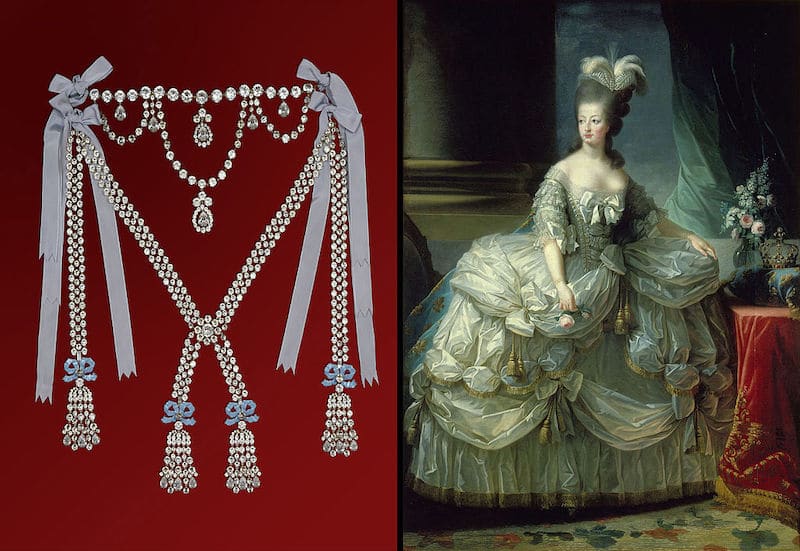
In 1782, Marie Antoinette wisely resisted temptation and turned down this necklace of 650 diamonds (2,800 carats), an extravagance offered at an exorbitant price! A few years later, a gigantic swindle would compromise her for good. The queen fell victim to a kind of identity theft. The culprits and their accomplices received varying punishments. Marie Antoinette was innocent, but the scandal irreversibly stoked the people’s hatred. At the Smithsonian Institution in Washington, you can see not the queen’s necklace, but diamond earrings said to have belonged to her.
Diamonds from the sky
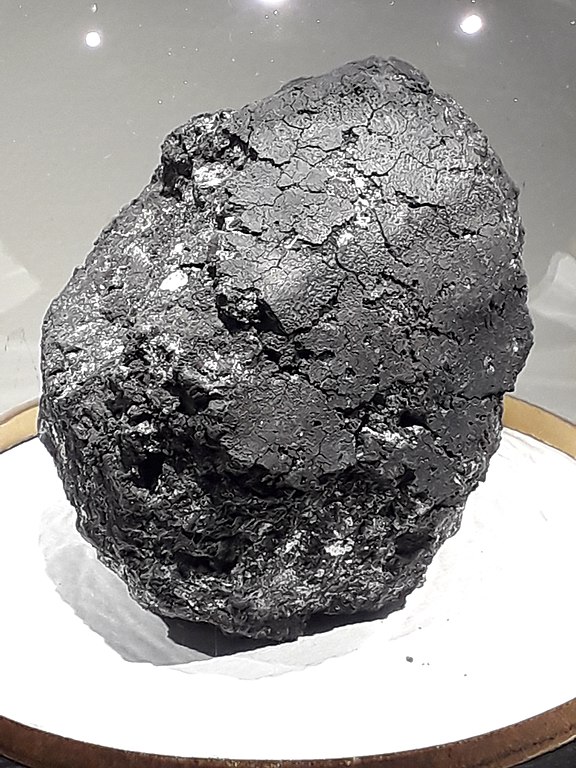
A precious meteorite
In May 1864, a meteorite, most likely a fragment of a comet, fell in a field near the small village of Orgueil, in the Tarn-et-Garonne area of southern France. Black, carbonaceous and glassy, it weighed 14 kg. This very rare chondrite contains nanodiamonds. Samples are still being studied around the world. In France, pieces are on display at the natural history museums of Paris and Montauban.
The diamond planet
This rocky planet goes by a more austere name: 55 Cancri e. Astronomers discovered it in 2011 and found that it is made mostly of diamond.
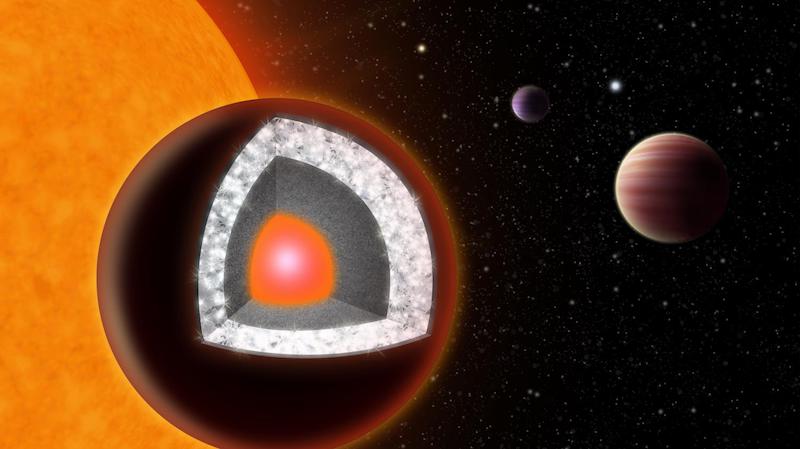
Twice the size of Earth and nine times heavier, it does not belong to the solar system. It sits in the constellation Cancer, 40 light-years from Earth (1 light-year = 9.461 trillion km).
One can already picture a fairy-tale planet explored by Tintin, with his faithful Snowy frolicking among dazzling stalagmites of giant diamonds. Research continues, but the reality is probably not so pretty!
Properties and virtues of diamond in crystal healing
In the Middle Ages, diamond was the emblem of constancy, the stone of reconciliation, fidelity and married love. To this day, 60 years of marriage are celebrated as a diamond anniversary.
Diamond is a great ally in crystal healing because, beyond its own qualities, it amplifies the virtues of other stones. This amplifying role, which stems from its extreme power, must be used with discernment, since it would also tend to intensify negative influences.
White (transparent) diamond symbolizes purity and innocence. Its purifying action keeps electromagnetic waves at bay.
Benefits of diamond for physical ailments
- Balances the metabolism.
- Relieves allergies.
- Soothes venomous stings and bites.
- Helps heal vision problems.
- Stimulates blood circulation.
- Promotes good sleep and keeps nightmares away.
Benefits of diamond for the mind and relationships
- Promotes a harmonious life.
- Gives courage and power.
- Lifts emotional pain.
- Eases tension and brings a sense of well-being.
- Brings hope.
- Attracts abundance.
- Clears the thoughts.
- Boosts the creative spirit.
- Encourages learning and study.
Diamond brings deep peace to the soul, so it is associated first and foremost with the 7th chakra (sahasrara), the crown chakra, linked to spiritual consciousness.
Cleansing and recharging diamond
For cleansing, salt water, distilled water or demineralized water will suit it perfectly.
Diamond holds such a source of energy that it needs no particular recharging.
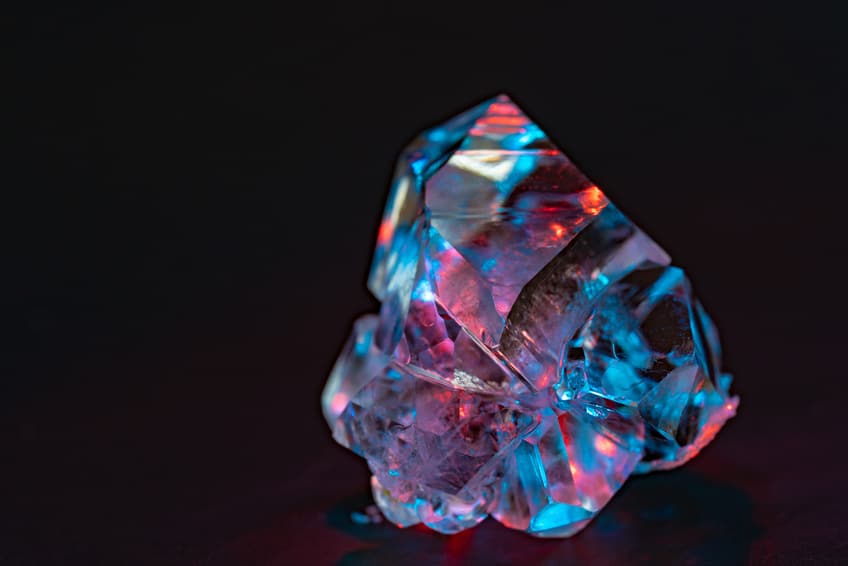
One last point: the “Herkimer diamond” so often mentioned in crystal healing is not a diamond. It is a very transparent quartz mined at Herkimer, in New York State.
Are you lucky enough to own a diamond? Have you noticed the virtues of this sublime mineral for yourself? Feel free to share your own experience in the comments section below!






Leave a Reply