 English
  Français
 Español

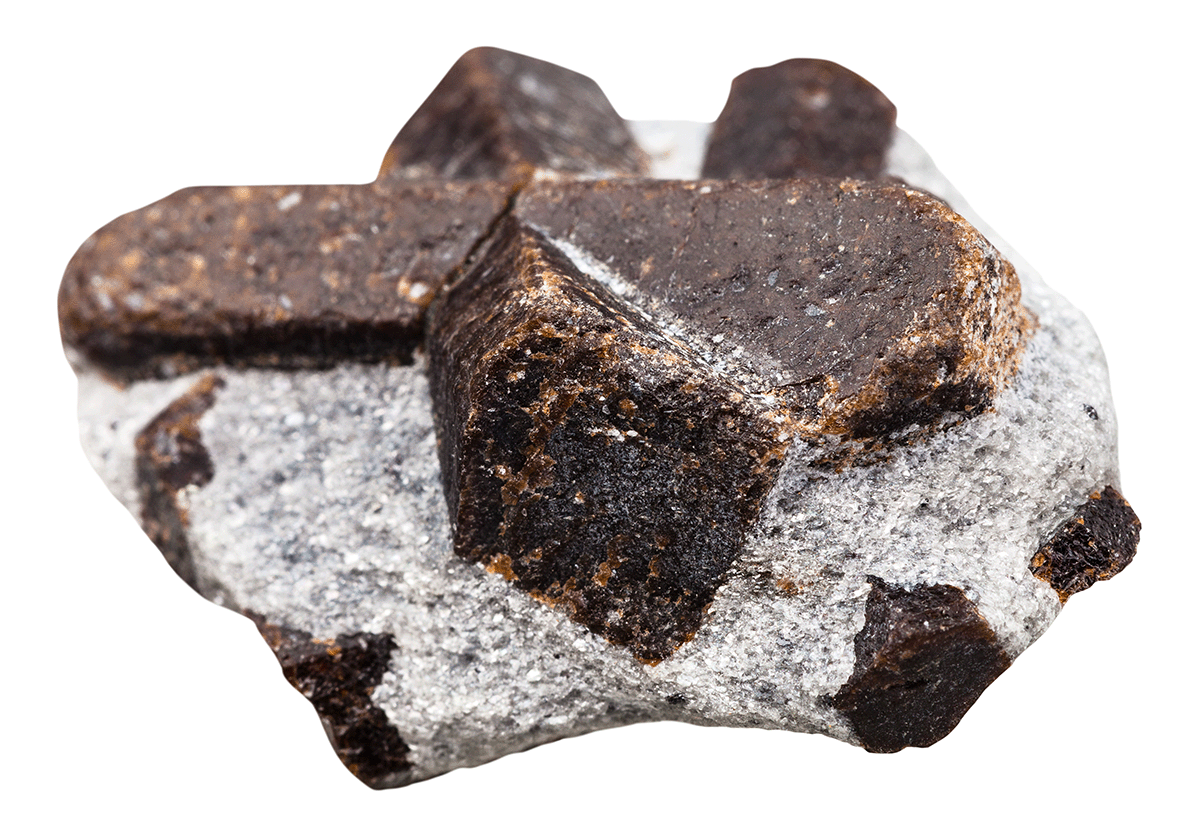
A stone of balance, grounding and protection hailing from Brittany, staurolite has been the subject of numerous traditions throughout the ages. It most often occurs in the shape of a cross, which is why it is directly associated with the death of Christ. In lithotherapy, this mineral also offers many beneficial properties. We invite you to discover them.
Characteristics of Staurolite
Mineralogical Properties
Staurolite stones are found in aluminous rocks, generally near the Rosporden granite. Their morphology has long intrigued mineralogists and crystallographers.
| Group | Silicates, nesosubsilicates subgroup |
| Crystal System | Monoclinic |
| Chemical Composition | Aluminum silicate, iron silicate, magnesium, cobalt, zinc, traces of chromium, manganese and titanium |
| Colors | Red, brown, black, possible traces of yellow or blue |
| Density | 3.7 |
| Hardness | Between 7 and 7.5 on the Mohs scale |
| Transparency | Transparent, translucent, opaque |
| Luster | Vitreous to resinous |
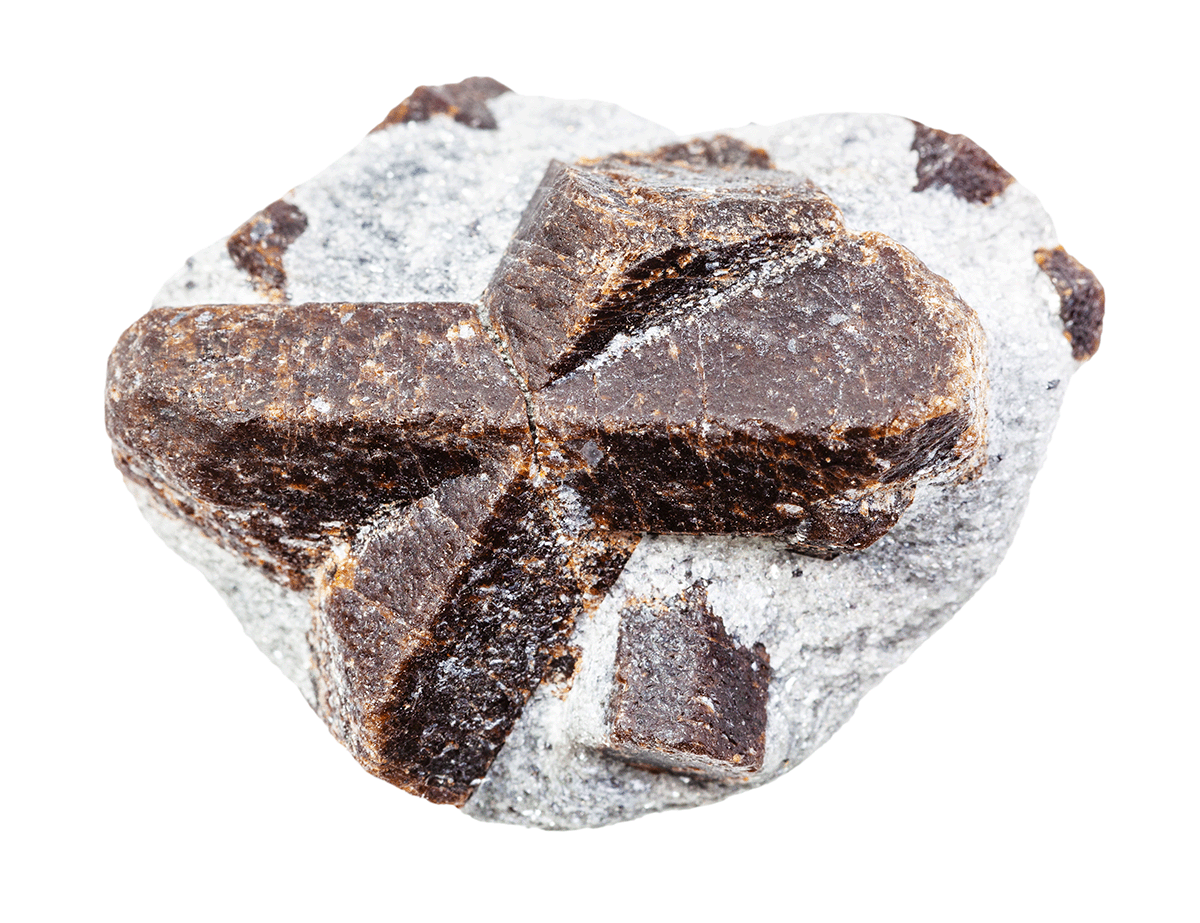
| Form | Single crystal, inclined twin, three-part twin, or crucifix shape |
| Deposits | Brazil, Russia, USA, Austria, France (Brittany), Namibia, Switzerland |
Staurolite Objects and Jewelry
Where Does the Name “Staurolite” Come From?
The name of this stone comes from the Greek “stauros” meaning “cross”, which can also be translated as “stake for torture” or “stake for palisade,” and from “lithos,” meaning “stone.” The root of the word, “sta,” is of Indo-European origin and means “to stand upright.”
The French-born mineralogist Jean-Claude Delamétherie first described staurolite in 1792. Later, his colleague René Just Haüy attempted to rename this stone “staurotide,” but this proposal was never officially accepted. However, this name is still commonly heard when referring to staurolite. It is also known by the names “staurolithe” or “croisette de Bretagne” (Brittany crosslet), owing to its shape. There are many other designations: Stone of the Cross, Greek Cross, Russian Cross, St. Andrew’s Twin, Fairy Cross (in Brittany) — all names given to staurolite across time and around the world.
History and Origins
The geometry of staurolite crystals has always fascinated mineralogists, because their structure is often perfect and takes the shape of a cross. This characteristic is entirely unique in the mineral world, and it is also what connects staurolite, among other things, to the story of the crucifixion of Christ. Nevertheless, the traditions linked to this stone are numerous.
Celtic fairy legends regard staurolite as the “fairy cross,” associated with the fertility of the land. The druids of that era used it extensively in rosaries, and Breton Christians had a custom of burying it beneath calvaries located at crossroads. According to them, these stones were crystallized fairy tears, shed after the death of Christ. Across the world, these crystals are considered good luck charms. It is said that they brought luck to many explorers and sailors throughout history.
In Greece, staurolite is known as the stone of Hermes, messenger of the Gods. In Madagascar, it is the “sacred stone” of the elders. In Brazil, staurolite represents the stone of Exu, an African spirit in the Yoruba religion.
The most significant staurolite deposits containing the finest stones are found in Brittany, in the surroundings of Coray, Baud and Scaër. They are also found in fields or rivers near dark mountain ranges, particularly in Armorica, where staurolite has been present for millions of years.
Like most minerals, staurolite can be found in various sizes and dimensions. What makes this stone unique and remarkable is its cross shape. These crystals may occur as a single crystal, as an inclined twin (a grouping of identical, symmetrical crystals) at 60°, as a three-part twin, or as a “St. Andrew’s crucifix.”
Symbolically and according to certain traditions, the cross shape of staurolite also relates to the notion of a crossroads — the idea of standing at a “turning point” in one’s life or at a “fork in the road.” It is linked to the need to make a choice, to choose a direction, as well as to redemption.
Staurolite Benefits and Properties in Lithotherapy
Physical Properties and Benefits
Staurolite is a stone that promotes overall physical balance. It helps maintain proper functioning of the body, of the organs, and the harmonization of bodily energies.
It acts particularly on the rib cage and the organs it contains. This type of stone therefore works on the heart, and consequently on blood circulation, heart rhythm, irrigation of organs and cells, etc. Lung health can also be improved through contact with staurolite. Ailments affecting these organs may also heal more easily in its presence (bronchitis, tonsillitis, etc.).
Staurolite can also have an effect on the feeling of satiety in some individuals. This may help reduce the onset of certain eating disorders such as bulimia, or regulate any form of dietary imbalance, whether pathological or not. As a result, its use can have an impact on weight gain or loss.
Psychological Properties and Benefits
Staurolite is a stone that facilitates achieving a certain emotional balance. Indeed, its vibrations help temper emotions and encourage positive feelings. It can therefore be particularly useful for making changes in one’s life. As a stone of alignment, it supports decision-making, choosing a direction in life and sticking to it.
Its connection to the earth and fertility fills its wearer with a sense of completeness that helps combat all forms of addiction. It helps its owner to center themselves and make the choices best suited to their well-being. A staurolite encourages better feelings and greater self-awareness, both emotionally and physically.
It also proves to be a purifying protection stone. In this regard, it can be very useful for therapists, clairvoyant individuals or those with other extra-sensory abilities. Staurolite is said to have the capacity to repel harmful energies and evil spirits. The most sensitive individuals can also use it to feel the energies of nature more deeply.
How to Use Staurolite in Lithotherapy?

Larger crystals, twins or other raw staurolite stones can be placed in a room to protect it from negative energies, as well as the people within it. Its presence can also attract luck.
Carrying a staurolite on your person, whether a polished stone, a tumbled stone or a piece of jewelry, provides the same benefits. Similarly, holding one of these minerals in your hand for a few moments can also help you regain alignment and centering.
Used in healing sessions, staurolite offers balancing functions for both body and mind. More specifically, a stone placed on a chakra will have the effect of balancing that chakra and acting on the organs corresponding to that area of the body.
Finally, elixirs made with staurolite, with or without other minerals, can also prove highly beneficial for both body and mind.
Chakras, Stones and Astrological Signs Associated with Staurolite
Which Chakras Are Associated with Staurolite?
Staurolite is a grounding stone, linked to rootedness and therefore to the root chakra (also called the base chakra). It is also particularly active at the level of the heart chakra, the seat of feelings of love toward oneself and others.
Which Stones Can Be Combined with Staurolite?
A staurolite can be paired with other stones, particularly those corresponding to the root chakra. These are black, brown or red stones such as the various types of garnet, tourmaline, obsidian, onyx, the various jaspers, etc.
Stones associated with the heart chakra can also be combined with staurolite. These are pink, green or golden stones: pink fluorite, kunzite, rose quartz, rhodochrosite, apatite, aventurine, chrysoprase, emerald, peridot, green fluorite, malachite, green tourmaline, pyrite, etc.
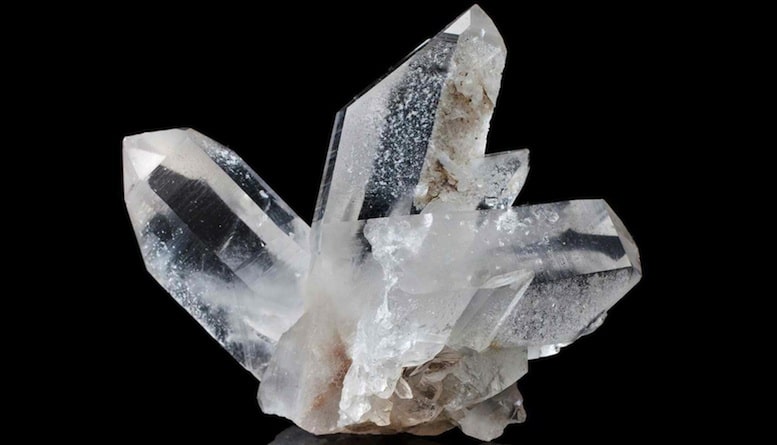
Finally, white stones are also relevant: colorless diamond, white topaz, etc., not forgetting rock crystal, which pairs beautifully with any mineral, regardless of its color.
Which Astrological Signs Are Associated with Staurolite?
A staurolite, like all minerals in lithotherapy, is beneficial to everyone regardless of their astrological sign. However, individuals born under an Earth sign will be more sensitive to its vibrations for emotional or physical balancing work: Taurus, Virgo and Capricorn.
Air signs — Gemini, Libra and Aquarius — are more likely to have their “head in the clouds,” and could more easily regain their grounding with the help of a staurolite.
How to Cleanse and Recharge Staurolite?
Cleansing and purifying staurolite stones does not require water. The best way to discharge the energies it has accumulated through use is to place it directly on the earth for a few hours (overnight, for example). Alternatively, it can be cleansed with incense or sage; it is worth noting that its self-cleansing abilities are nonetheless quite significant.
To recharge staurolite stones, simply expose them for several hours to a full day in direct sunlight.







Leave a Reply