 English
  Français
 Español

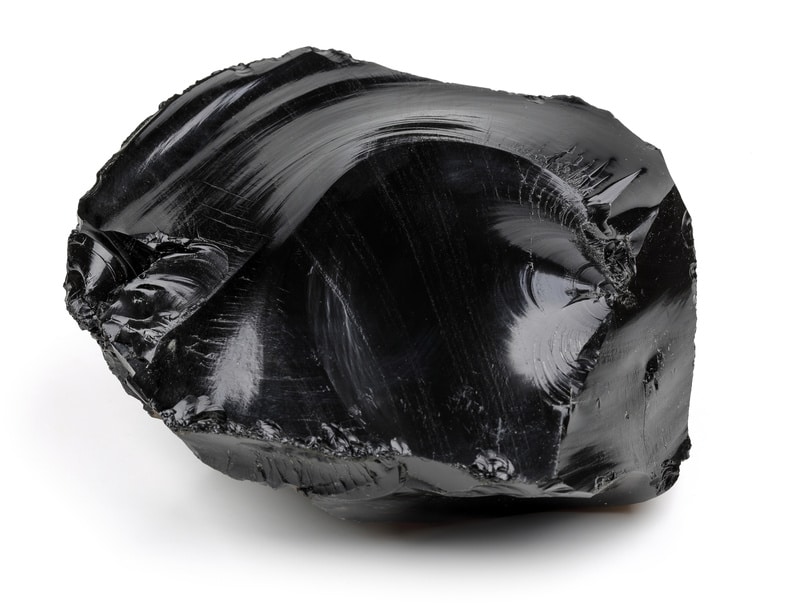
The Roman soldier Obsidius brought back to his city a dark, shiny stone he had just discovered in Ethiopia. From then on it was named in his honor “lapis obsidianus“, the stone of Obsidius: obsidian.
Who was this mysterious figure? Few accounts tell us, but the volcanic stone was known long before it bore his name. Since prehistoric times, every civilization that had obsidian at hand made use of its cutting edge and its reflective surface. Many ancient statuettes owe it their deep gaze.
In this article, we take you on a tour of obsidian: its mineralogical characteristics, of course, but above all its place in history and its virtues and benefits in crystal healing.
Mineralogical characteristics of obsidian
Obsidian is a volcanic rock. Sudden cooling turned viscous lava into a hard, glassy material. Rock formed this way has no time to crystallize, so it shows no ordered atomic structure: it is said to be amorphous.
It consists mainly of silica and glass. Hard yet brittle, obsidian breaks with a clean, conchoidal fracture (a curved shape, concave or convex) that makes it fairly easy to knap. That is why it was worked so widely from prehistoric times onward. Being vitrified rock, it does not withstand fire: it melts and blisters. Its hardness lies between 5 and 5.5 on the Mohs scale.
Colors and varieties
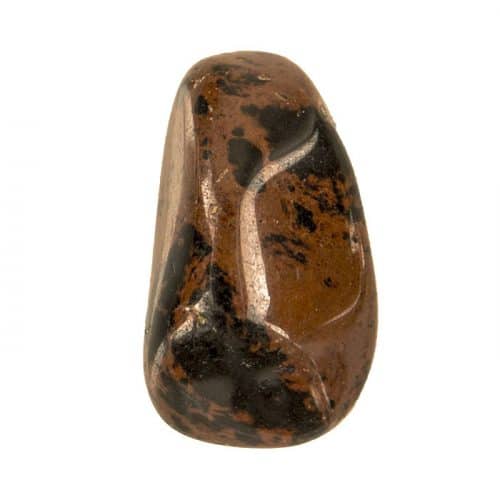
Mostly black, obsidian comes in many other colors owing to small differences in composition or structure. The presence of hematite accounts for every shade of red, russet, mahogany and brown. Green obsidian usually contains chromium. Early devitrification sometimes gives it golden or silvery reflections, caused by tiny gas bubbles. Another spectacular variety shows iridescent tones: it goes by the name of rainbow obsidian, celestial eye or mentogochol obsidian.
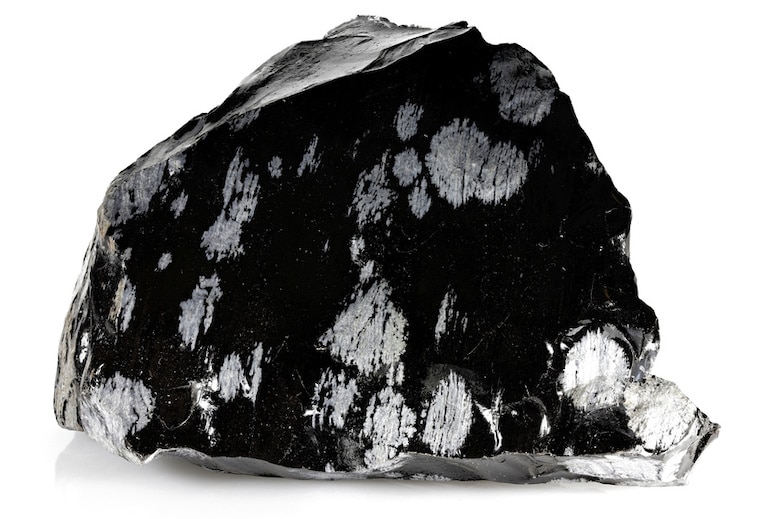
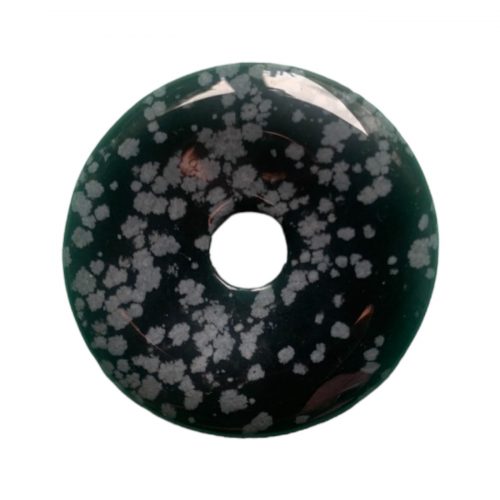
The most popular for its decorative qualities is still snowflake obsidian. Glass makes up the vast bulk of this obsidian, but minute spherulite crystals have replaced it here and there, producing a pretty gray-white flecking.
As for the small, smooth, shiny fragments of obsidian from the Arizona desert in the United States, they are sold under the trade name “Apache tears“.
Origins and possible confusions
Obsidian occurs near the lava flows or lava domes of certain volcanoes, whether presumed extinct or still active. It is found on almost every continent: in Africa, the Americas, Asia and Europe (notably in France, in the Massif Central).
Obsidian can be confused with onyx, black tourmaline, gadolinite… Historically it was mistaken for jet. Apart from the black color, the two have nothing in common, since jet comes from decomposed plant matter.
Obsidian jewelry and objects


Etymology of the word “obsidian”
Obsidian owes its name to a sentence written by Pliny the Elder in the 1st century AD, in his famous encyclopedia “Natural History”: “The stone that was discovered in Ethiopia by Obsidius…“.
This proper name comes from the Latin word obsidio, which refers to the military act of laying siege. It is built from the preposition ob (before) and sedeo (to sit, to be stationed). A Roman general who achieved the glorious feat of lifting a siege was honored with the obsidionalis corona, the obsidional crown.
In France, the name obsidienne first appears in its modern form in an encyclopedia from the early 18th century. In the preceding centuries one finds the form “obsianne”, then “obsidiane”.
The history of obsidian
Human use of obsidian dates back to prehistory, to the early Neolithic. This sharp black stone made a good alternative to flint. Obsidian scrapers, arrowheads and knives some ten thousand years old have been unearthed, notably in Mesopotamia and Slovakia. The civilizations of antiquity would go on to refine the way obsidian was used.
Ancient Egypt
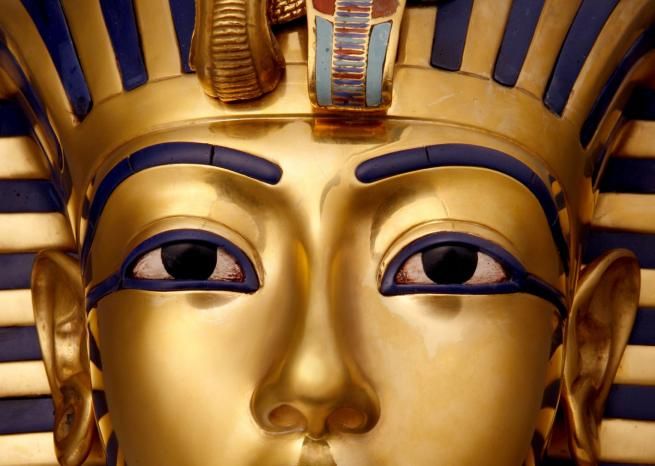
The Egyptians made surgical instruments from it for performing trepanations and circumcisions. They also used it for seals, or as an ornamental stone carved into vases, cups and statuettes. The mysterious gaze of Tutankhamun’s funerary mask comes alive thanks to obsidian inlays.
Ancient Rome
Pliny the Elder is the only one to report the story of the Roman soldier bringing stones back from Ethiopia, so much so that some have doubted its authenticity. And yet history has preserved, well hidden, traces of two men in the Roman armies named Obsidius.
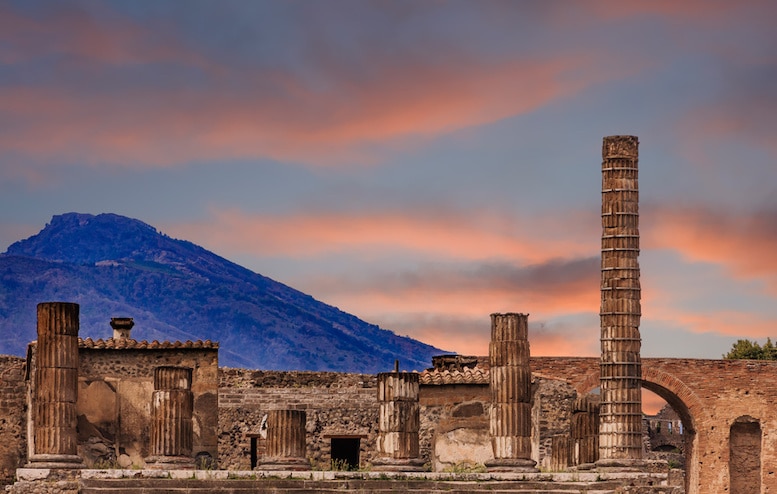
Be that as it may, the emperor Augustus clearly liked obsidian, since he decided to adorn the sacred Temple of Concord, built near the Capitol, with four elephants carved from this rock. Nobody knows how big the stone pachyderms were, for this once prestigious building is nothing but ruins today.
Ancient Greece
Greek obsidian turns up under the name “cinaedius stone” among the 24 entries of a treatise on magic dating from the first centuries AD: the Kyranides. Drawing on Chaldean and Egyptian beliefs mixed with Christian influences, this work written in Greek is one of the oldest and most enigmatic lapidaries to have come down to us:
“The cinaedius stone was unknown because of the difficulty of telling it apart: it is the one called obsidian: it is the stone of Saturn. It is of two kinds: one is matte and black, the other black too, but shining like a mirror. It is the latter that many desire, and they do not know it, for it is the stone of the serpent.”
Pre-Columbian civilizations
Obsidian is everywhere in the pre-Columbian civilizations. In Central America, the archaeological site of Teotihuacán, near Mexico City, has yielded a great many obsidian tools. The Mixtecs, highly skilled at knapping, used it extensively, as did the Maya and the Aztecs. Called ixtete, itzli or teoteti, this obsidian came mainly from the mountain Itzepetld, or “obsidian hill”. To the Spanish conquerors it would become the Sierra de las Navajas, “the mountain of knives”.
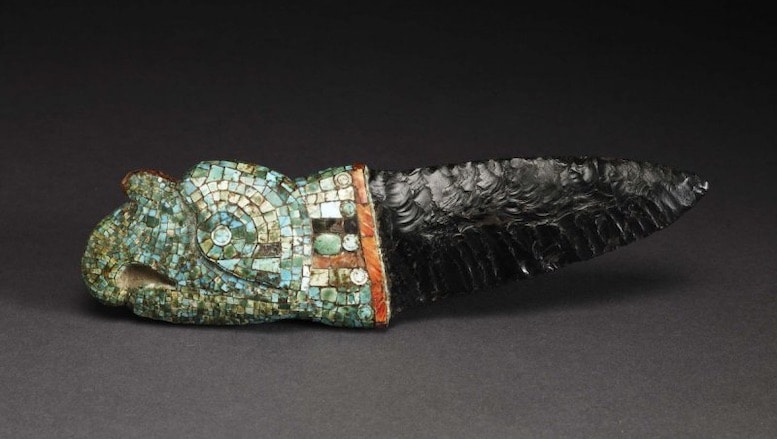
Invested with sacred and magical powers, this black stone held pride of place in human sacrifices, which were extremely common, above all among the Aztecs. Some rather macabre rituals were carried out with a razor-sharp obsidian knife. To put it bluntly, the instrument served to open chests and tear out hearts! Paradoxically, obsidian is also a stone known for its wound-healing virtues. It is therefore used in crystal healing in powdered form.
In South America, the green obsidian of the Andes was knapped by the Incas. They often shaped it into the famous sharpened axes they traditionally wore strapped to their wrists. Obsidian also featured in their funeral rites. It accompanied and protected the deceased in the tomb, in the form of small cut pieces known as the money of the dead.
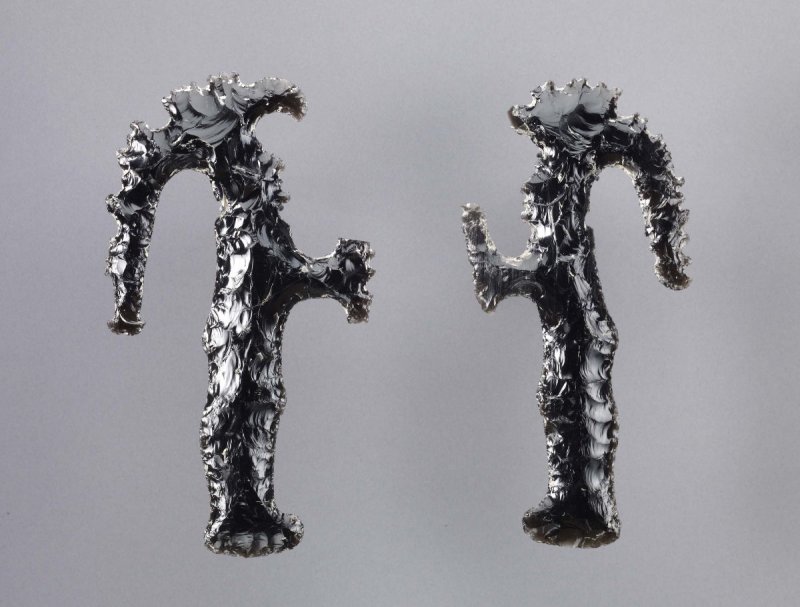
Obsidian and mirrors
Obsidian has sometimes been nicknamed the “mirror of the Incas”, but every civilization used it for that purpose. In Mexico, an obsidian mirror is the divinatory attribute of the fearsome Aztec god Tezcatlipoca (whose name means “smoking mirror”).
The Egyptians and the Greeks also knew obsidian mirrors before replacing them with bronze, silver or a variety of hematite called specularite. A polished obsidian mirror, after all, stays dark. According to Pliny, “it shows the shadows of objects rather than the objects themselves“. Landscape painters exploited this peculiarity for a long time. Set on a rotating mahogany stand, the mirror throws back a chiaroscuro image that inspires the artist and makes the work easier.
These “black mirrors” still hold an element of mystery. Their magical power is generally reputed to be malevolent. In the tale of Snow White, the wicked queen owns one. In real life, John Dee, the famous 16th-century English alchemist, used one for his occult experiments: it can be seen today at the British Museum in London.
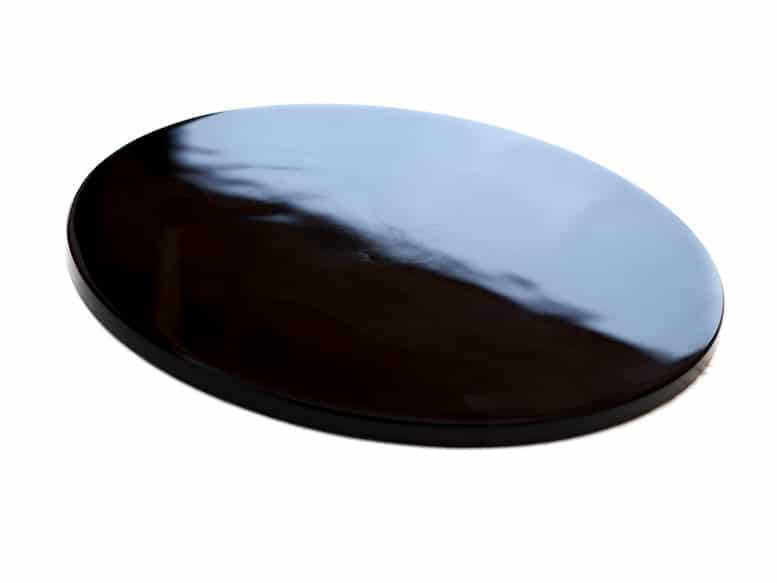
In Europe, the beautiful satin-black obsidian found at the foot of Mount Hekla in Iceland is particularly well suited to making these mirrors. Telescopes would be fitted with them for a long time. Much sought-after mourning jewelry was also made from this obsidian, commonly called “Iceland black agate”.
Virtues and benefits of obsidian in crystal healing
Obsidian, especially the black kind, radiates powerful protection, and people commonly say it behaves like a shield. Negative energies cannot stand up to it, but it must be used with care, and it is not usually recommended for children.
It fights deep-seated malaise by sometimes dredging up the old life wounds responsible for that state. For this reason, crystal healers often nickname it the stone of truth. The old adage that “some truths are better left unsaid” does not apply here, because this awareness turns out to be beneficial in the end. You just have to be ready for it.
Where energy balance is concerned, obsidian works first and foremost on the root chakra and the third eye chakra. Astrologically, obsidian is associated with Capricorn and Scorpio, although this black stone will bring its benefits to every other sign as well.
Benefits against physical ailments
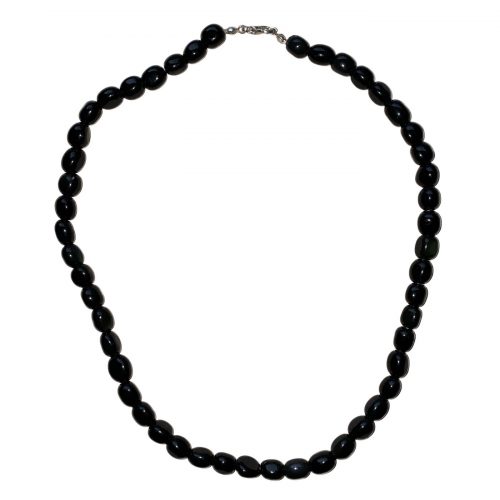
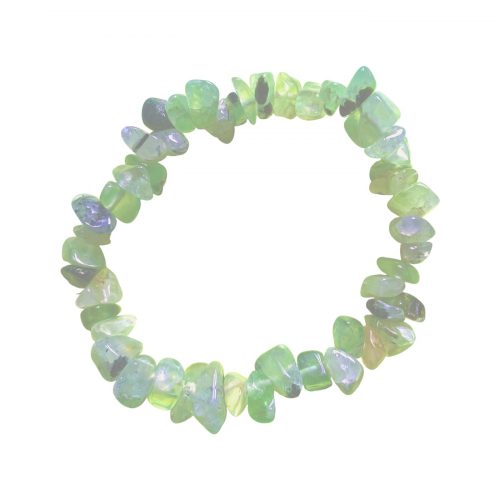
Obsidian is used in crystal healing for its strengthening and soothing virtues. You can either apply it directly to the skin, for instance to relieve unpleasant symptoms, or wear it on you as a tumbled stone, a bracelet or a necklace.
Here is a list of its main virtues on the physical side:
- Relieves cramps, rheumatism, osteoarthritis and arthritis.
- Calms pain in general.
- Purifies the blood and protects the kidneys (a good detoxifying effect).
- Promotes good blood circulation.
- Helps wounds to heal.
- Soothes irritations and allergies.
- Strengthens the body as a whole.
- Calms nausea and intestinal irritation.
Note that obsidian elixirs are for external use only, for skin problems or, with blue obsidian, for the eyes.
Benefits for the mind and relationships
Obsidian is also a protective stone, one that shields against negative energies by absorbing them. That is one reason people use it, though not the only one. It brings clarity and calms the mind just as it does the body. With this in mind, it is advisable to wear obsidian, this lovely semi-precious stone, as jewelry, such as a bracelet or a necklace.
Here are the main benefits it brings on the mental and spiritual side:
- Promotes inner peace.
- Clears up muddled thoughts.
- Strips away vain illusions
- Encourages reflection.
- Soothes anxious states.
- Makes introspection easier.
- Aids deep meditation.
You can place an obsidian in your home: it will fight negative energies, absorb pollution and contribute to the well-being of the people living there.
Specific traits of each color and variety
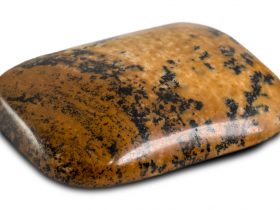
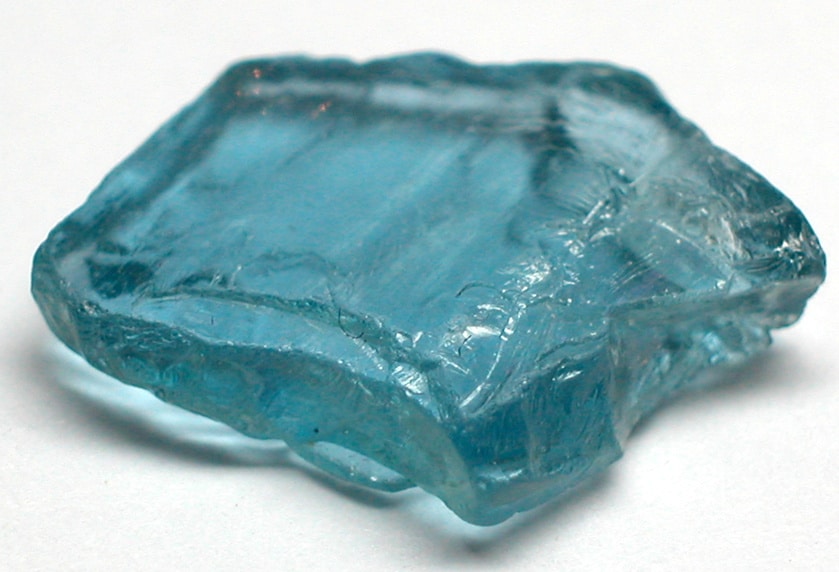
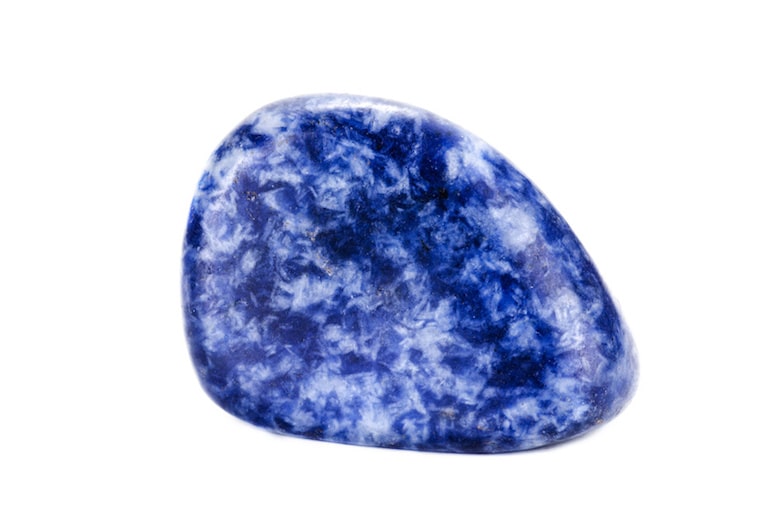
Bear in mind that obsidian comes in several colors: black, blue, speckled, rainbow, mahogany… Each stone thus has its own characteristics, depending on its coloring.
- The brown and mahogany tones have gentler effects than the black.
- The blue calms eye irritation; it is also recommended specifically for speech and behavioral disorders.
- The golden and silver ones work very well for understanding things and for meditation.
- Snowflake obsidians bring gentleness and calm.
- Rainbow obsidians help the soul rise by dispelling negative influences.
- Little Apache tears soothe grief.
Stones to pair with obsidian
You can use obsidian in combination with other stones it pairs particularly well with, while others are best avoided. As is often the case, the first stones to pair it with are those of the same color. Black obsidian therefore goes with onyx, jet and black tourmaline to reinforce their respective effects. Combining obsidian with clear quartz also strengthens the effects of the former, the quartz playing its well-known role as an amplifying stone.
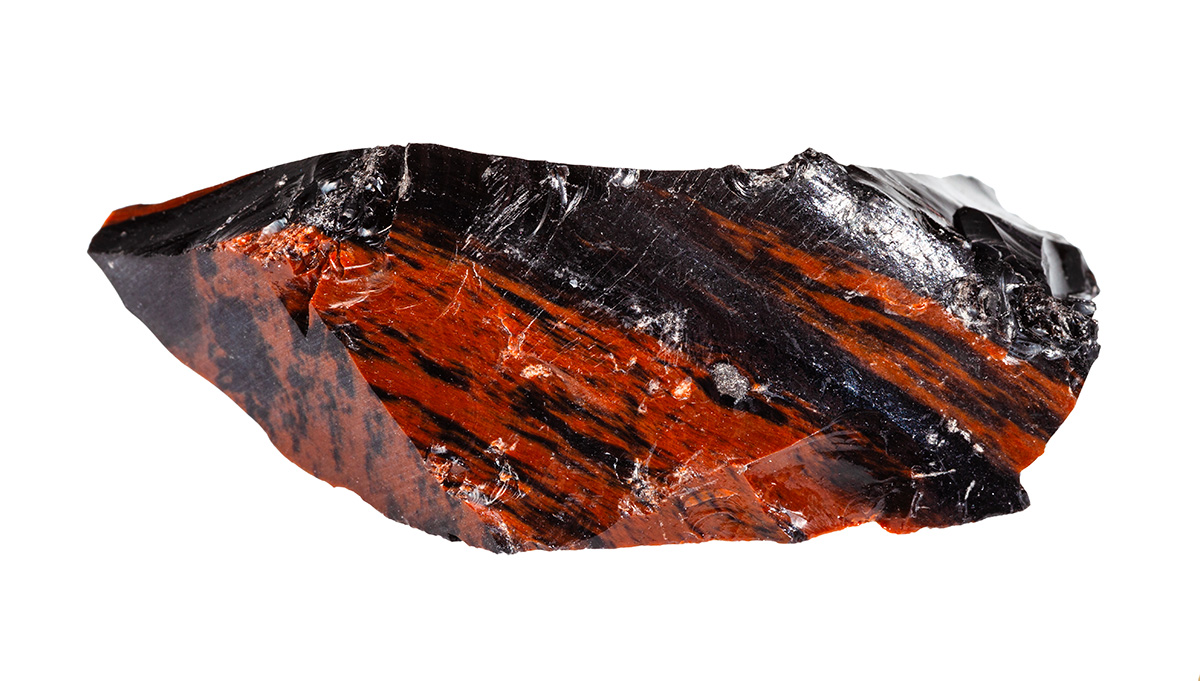
Among the lesser-known but particularly effective pairings is that of black obsidian and rose quartz. The pair is used for protection and works like a shield against negative energies.
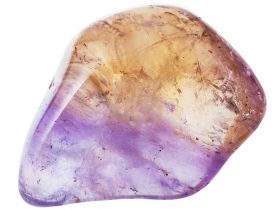
You can also pair obsidian with amethyst. The idea here is to combine the seemingly opposite virtues of the two stones to open new paths for your spiritual growth.
Finally, take note of the pairings to avoid with obsidian. Pairing obsidian with tiger’s eye is not recommended, because the two stones have contradictory effects. Where obsidian serves to absorb negative energies, tiger’s eye repels them.
Cleansing and recharging
Obsidian is cleansed simply under running water. You can discharge it under a trickle of tap water, but to avoid waste we would rather suggest leaving it to soak in a bowl of water overnight (go for a container made of a natural material, such as glass, porcelain or ceramic).
Obsidian is best recharged in sunlight. You can leave it for half a day on a windowsill that gets the sun, in the morning or the afternoon alike. Unlike some other minerals, obsidian is not bothered by strong natural light. On the contrary, it will soak up energy and give it back to you when you wear it or use it during meditation or crystal healing sessions.




Leave a Reply