 English
  Français
 Español

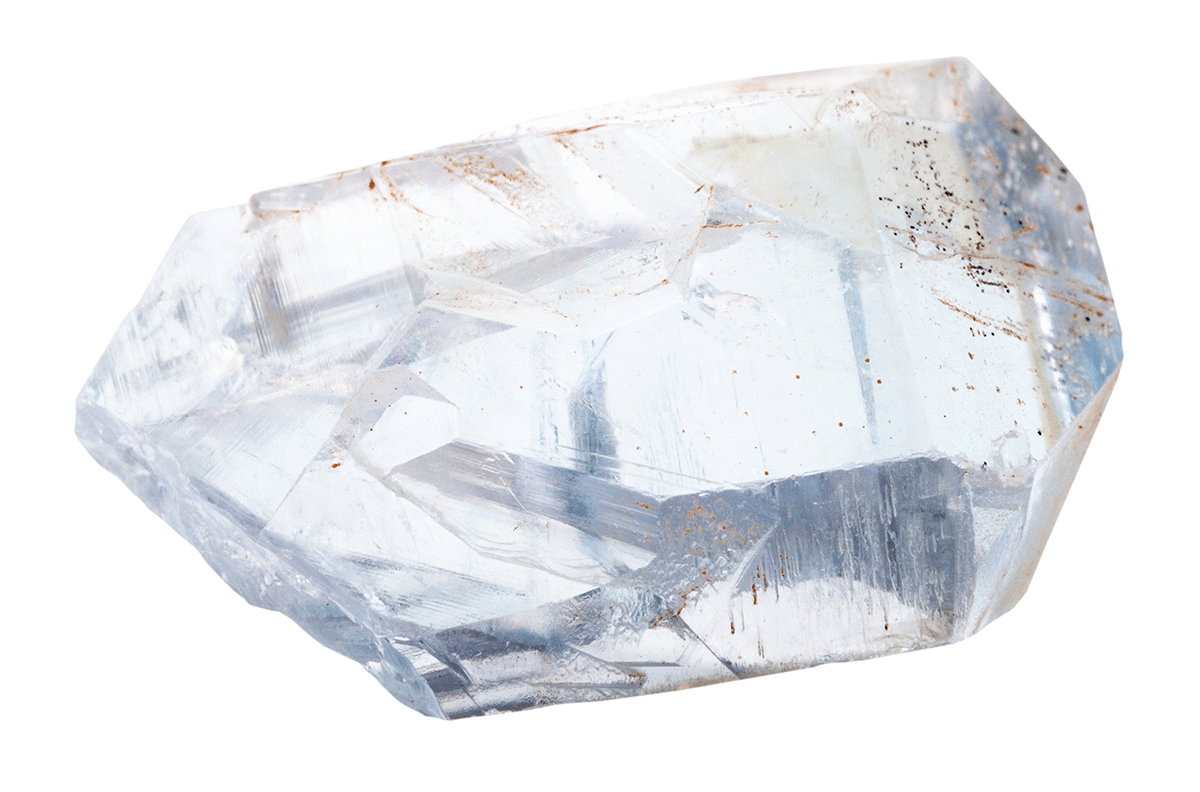
Celestite is a stone highly valued for its blue color and its chemical composition. Used in the sugar industry, it is even more prized in lithotherapy. Long associated with the purity of the sky, celestite is a soothing stone with subtle and spiritual energies, also known as the Angel Stone. Discover the many properties and virtues of celestite.
Characteristics of the Celestite Stone
Mineralogical Properties of Celestite
Celestite is a crystal rich in mineral salts, closely related to barite. It originates in volcanic rocks and other hydrothermal environments, most often forming on other stones such as calcite, and in a more or less scattered manner within sedimentary rocks.
| Group | Sulfates |
| Crystal System | Orthorhombic |
| Composition | Sulfur, strontium sulfate, SrSO4 |
| Colors | Colorless, blue to mauve, presence of blue-green impurities, light red to brownish or yellow |
| Density | Between 3.97 and 4 |
| Hardness | Between 3 and 3.5 on the Mohs scale |
| Transparency | Transparent to translucent |
| Luster | Vitreous, nacreous, or pearly |
| Form | Crystals, geode, nodule, elongated prism more or less flattened, more rarely tabular |
| Deposits | Austria, United Kingdom, Germany, Brazil, Mexico, Spain, France, Poland, Canada, Italy, Madagascar, Libya, Slovakia, Russia |
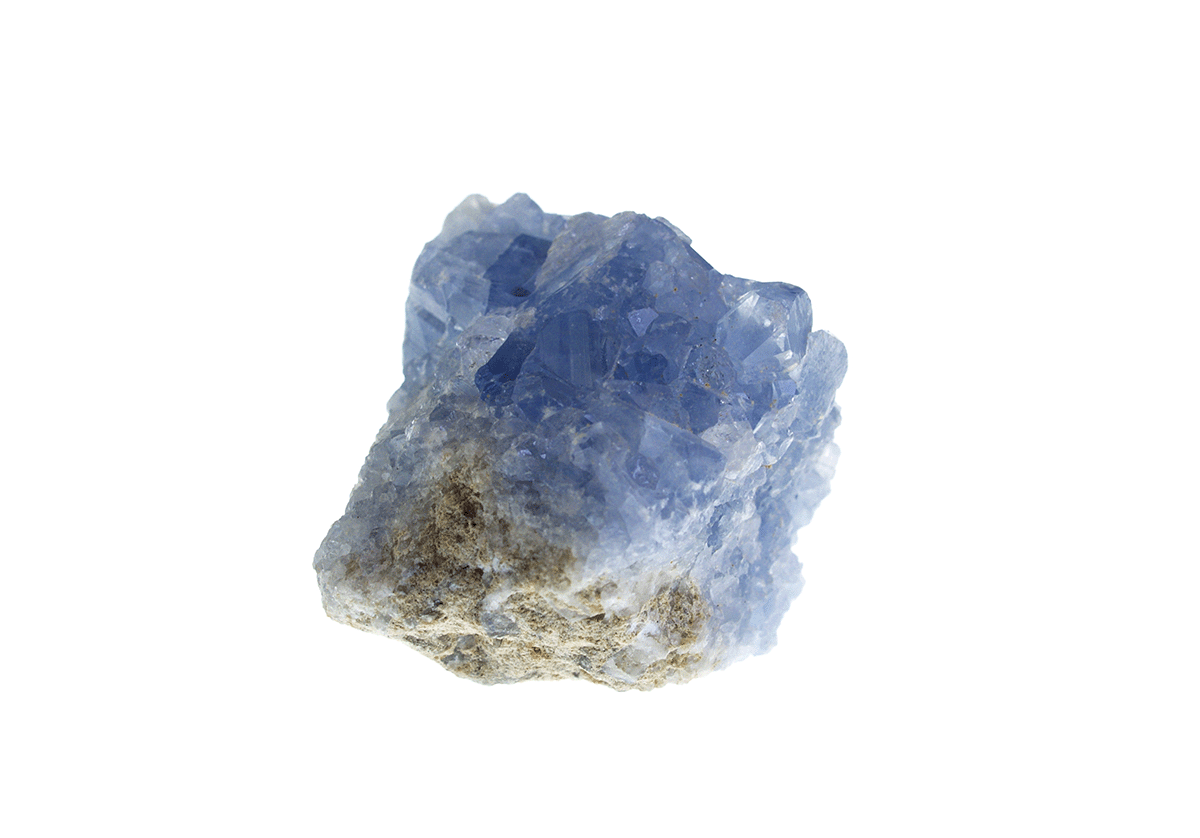
Where Does the Name “Celestite” Come From?
The celestite stone takes its name from the Greek “coelestis,” meaning “celestial,” and from the Latin “caelestis,” meaning “come from the sky.” This is why the mineral is also commonly called the “Angel Stone.”
This name is also said to be a tribute to Saint Celestine, pope in 1294, honored on the feast day of Celestine, before he withdrew to a solitary life. The Romans, for their part, called this stone “Aqua-Aura,” a name now reserved for certain rock crystals that have been chemically treated to give them a blue color.
Other derived names have also been given to this precious stone, such as coelestine, colestine, celestine, or other less well-known ones: cliftonite, dioxynite, deschwegite, schutzite, sicilianite, or strontiane sulfatée.
History and Origins of Celestite
The celestite stone was discovered in 1797 in Madagascar by the German mineralogist and chemist Martin Heinrich Klaproth. A year later, his fellow geologist Abraham Gottlob Werner cataloged it and officially gave it the name we know today: celestite. It was named in reference to its blue color, reminiscent of the sky. Indeed, the first celestite minerals were blue.
Celestite is a stone steeped in symbolism and tradition. Certain civilizations attributed to it a meaning of unification of matter. The Greeks associated it with divine power, regeneration, wisdom, and prudence. In tarot, it represents the stone of judgment. Other legends hold that it was born from the song of angels or linked to the Pleiades.
Alchemists and magicians in Antiquity already used the celestite stone for its many qualities. At that time, only those initiated into the occult sciences and esotericism held knowledge of this stone, which remained largely unknown to the general populace. Widely distributed across the Mediterranean region and throughout the world, the crystal was used in all its forms: raw or solid, as an essence, an elixir, or ground into powder.
Celestite was rarely used in jewelry in the past. It was primarily exploited as a strontium ore, notably as a salt in various industrial fields. Today, celestite continues to be used in multiple ways in lithotherapy.
Virtues and Properties of the Celestite Stone in Lithotherapy
Physical Properties and Benefits
Celestite has relaxing virtues. As such, it can help to soothe physical tensions and pain in general. It acts particularly on back pain, migraines, as well as abdominal pain during painful periods.
The celestite stone is active on ailments affecting many organs. In the chest area, it is beneficial for the lungs and improves breathing, asthma, and lung infections. It also acts on the ENT area, particularly on eye and ear problems such as otitis. At the level of the throat, it addresses swallowing difficulties and tonsil issues.
The vibration of this mineral is beneficial to the entire body and organism. It promotes good circulation of lymphatic fluid and blood, allowing for better irrigation of organs and tissues. In this way, the celestite stone slows tissue aging, facilitates their regeneration, and absorbs nodules. It also helps wounds heal more quickly.
Finally, celestite minerals have an influence on the thyroid gland. They thus act on hormones, libido, and fertility. The celestite stone also proves particularly useful in cases of infertility, amenorrhea, painful menstruation, or during a difficult menopause.
Psychological Properties and Benefits
A stone of gentleness in lithotherapy, celestite is particularly beneficial for children or vulnerable individuals. It provides calm, peace, and inner harmony, which helps to ease tensions, anxiety attacks, and to strengthen feelings of security. It also reduces feelings of oppression or stress.
Celestite helps to strengthen self-confidence, notably by reducing feelings of inadequacy in the wearer. It also improves communication, eliminating stage fright or other fears when speaking in public.
It is a natural stone conducive to relationships, whether friendly, romantic, or professional. It helps to avoid conflicts and strengthens feelings of love and kindness toward oneself and others. It thereby allows one to be more available for oneself and those around them.
Celestite also acts on the mind and creativity. It is thus connected to the arts and clairvoyance. It fosters imagination and expression through artistic creation. Thanks to this very useful stone in meditation, access to spiritual consciousness and a sense of peace becomes easier.
How to Use Celestite in Lithotherapy?

It is possible to use celestite during a lithotherapy session or meditation. Polished or tumbled stones are particularly well suited for this purpose. A tumbled celestite stone placed on the throat will improve expression and communication abilities, while another placed on the third eye will further facilitate access to higher planes or the expression of creativity. In the same way, a polished or tumbled celestite stone placed over the heart will align all the body’s chakras.
As in Antiquity, celestite can be used to prepare elixirs or gem waters. These preparations, which can be drunk or applied to the skin, allow one to benefit from all the virtues of the minerals.
Celestite is a soft stone that is less suited for crafting semi-precious and natural stone jewelry. However, various products exist that allow you to enjoy the vibrations of the minerals: celestite jewelry sets, earrings, pendants, rings, bracelets, etc.
Finally, raw celestite crystals come in various forms. The larger ones can easily be placed in a room of the house to diffuse their soothing vibrations. This could be a home office, a bedroom, or a therapy treatment room. A celestite geode can frequently be used as a collector’s item.
Chakras, Stones, and Astrological Signs Associated with Celestite
Which Chakras Are Associated with Celestite?
Celestite is associated with the throat chakra, the energy center of communication and authentic expression. It also corresponds to the heart chakra, the seat of love and compassion toward oneself and others, as well as the third eye chakra, linked to the mind, intuition, and extrasensory abilities.
Which Stones Can Be Combined with Celestite?
In lithotherapy, celestite can be combined with stones that share similar properties. Preference is therefore given to stones that act on the mind, intuition, and the development of extrasensory abilities. These include amethyst, tanzanite, and larimar. These are connected to the third eye chakra and are generally purple in color, though not exclusively. This chakra also includes dark blue stones such as hawk’s eye, labradorite, blue aventurine, blue apatite, azurite, sodalite, and sapphire, as well as yellow stones such as yellow calcite, citrine, and tiger’s eye. Celestite can also be combined with stones from the same geological environment. This is notably the case with pyrite, fluorite, and rose quartz.
Which Astrological Signs Are Associated with the Angel Stone?
The vibrations of celestite are favorable to all signs, particularly those that may display a rather rigid temperament or lack tolerance. This is why this stone is especially suited to the signs of Pisces and Aquarius. It is also well suited to the signs of Gemini and Cancer. You can of course benefit from its properties regardless of your astrological sign.
How to Cleanse and Recharge Celestite?
Cleansing the Stone
Once removed from their original environment, stones lose their ability to self-regenerate. This is why it is important to regularly proceed with the cleansing and purification of stones. Regarding celestite, it can be cleansed through the vibrations of a singing bowl or Tibetan bowl, by fumigation with incense or Native American sage. Celestite is a stone that is sensitive to water.
Recharging the Stone
After being cleansed, it is advisable to recharge stones with energy. Celestite can be recharged by placing it on a flower of life, or by exposing it to moonlight during the night. It is a light-colored stone that may become damaged when exposed to sunlight.






Leave a Reply