 English
  Français
 Español

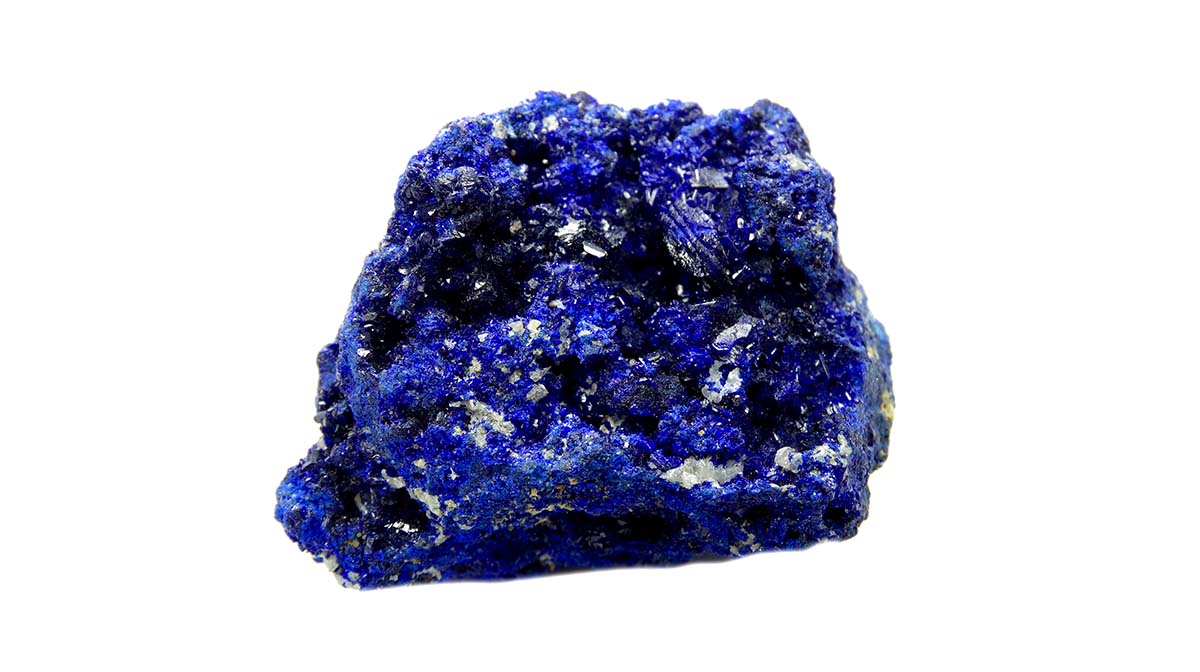
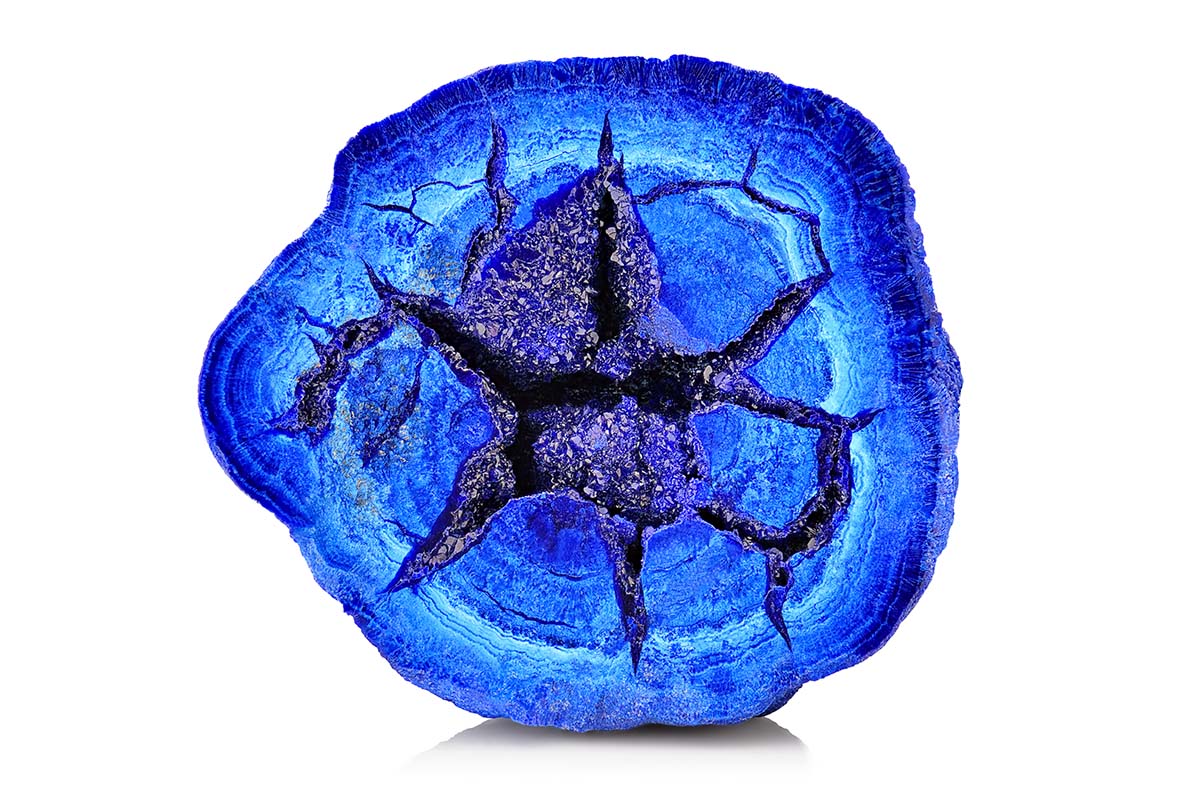
Azurite is a stone whose magnificent range of blues shifts between azure, indigo and ultramarine. It occurs as compact masses but above all as crystals rich in numerous facets with a prismatic appearance. Translucent and with a vitreous lustre, the azure stone often transforms into malachite over the course of time. Several locations around the world produce azurite crystals, notably in Australia and France.
Mineralogical properties of azurite
| Group | Basic carbonates |
| Crystal system | Monoclinic |
| Composition | Basic copper carbonate |
| Colours | Dense ultramarine blue, light indigo blue |
| Density | 3.77 to 3.79 |
| Hardness | 3.5 to 4 |
| Transparency | Translucent |
| Lustre | Vitreous |
| Forms | Crystals or compact masses in efflorescence |
| Deposits | Mexico, Russia, Arizona, Morocco |
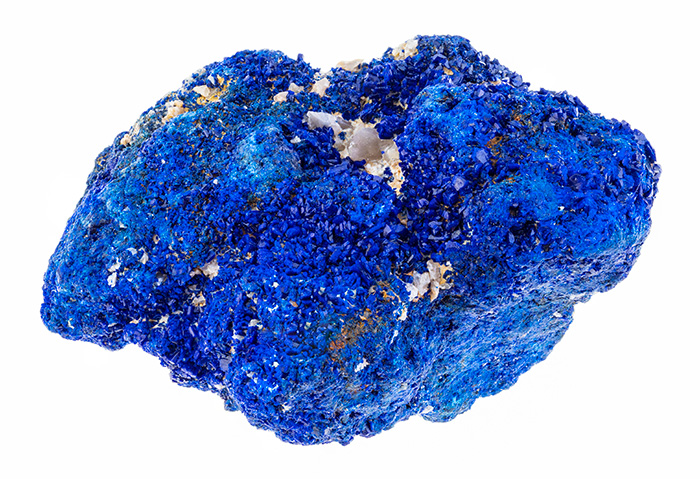
The varieties of azurite
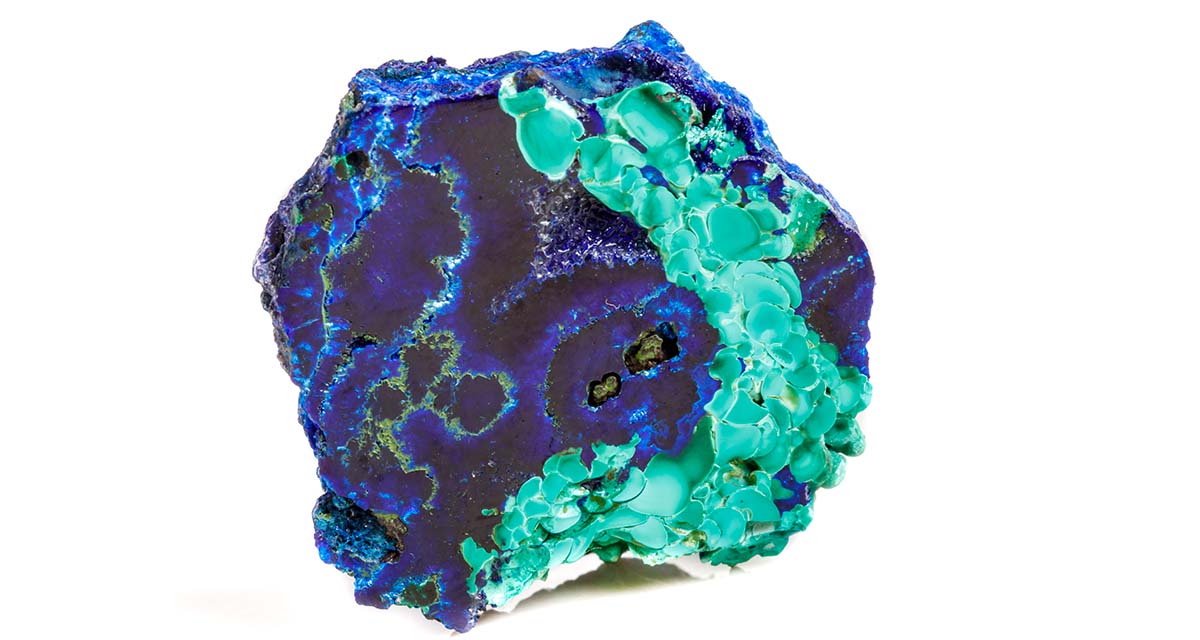
Rarely pure in its rough state, azurite readily associates with the surrounding minerals and commonly metamorphoses into malachite. In nature, azurite and malachite are often found intermingled, as their chemical composition and crystal system are identical. This variety is then named by juxtaposing their two names. Chrysocolla, azurmalachite or benite form specific combinations of azurite and malachite.
Jewellery and objects made of azurite and azurite-malachite
-
 Select options This product has multiple variants. The options may be chosen on the product pageQuick ViewAzurite-Malachite, Pierres Roulées
Azurite-Malachite – Pierre Roulée
Price range: 20,00€ through 40,00€
Etymology of the word “azurite”
The Greeks called it “kuanos“, the ancestor of the word “cyan”. Among the Romans, this stone was known by the names coerulum or armenium. It was only at the beginning of the 19th century that the origin of its current name emerged through the Persian term “lazhward“. The latter denotes the colour blue, just as, by extension, an azure sky now evokes the hues of azurite. It was François Sulpice Beudant, a geologist specialising in mineralogy, who gave it the name azurite.
The history of azurite
The earliest uses of the blue stone
The original traces of the use of this mineral come from ancient Egypt, a civilisation dating back more than 3000 years before our era. The Egyptians, aware of the beauty and intensity of its colour, extracted azurite to make pigments. These were then incorporated into paints and works of art. Historians have also brought to light the use of this stone in the Greek and Roman civilisations.
The Middle Ages: colours and symbolism
In the Middle Ages, the bluish hues of azurite, then called coerulum, had lost none of their renown. The stone was used in particular to colour manuscripts. Over in Central America, the Maya civilisation, which saw the end of its era in the 16th century, already attributed metaphysical virtues to azurite. It symbolised the wisdom of the heart as well as a form of connection between man and a higher intelligence.
Yesterday and today
Since at least the 18th century, azurite has been cherished by painters, jewellery craftsmen and collectors. Its tendency to turn malachite green under certain conditions makes it a delicate stone to work with and to preserve.
The properties of azurite in lithotherapy
Lithotherapy perceives azurite as the mineral symbol of intuition. The stone that opens up the horizons of possibility and expands extrasensory potential. A representation of the divine and the mystical, this mineral with subtle properties flirts with the world of the magical and the unexplained.
Azurite resonates with the astrological sign of Sagittarius. Fond of experiences, open-minded and sensitive, the Sagittarius loves inner journeys and adventures. Azurite guides them in their search for meaning and heightens their clairvoyance.
Its properties are connected to three chakras in particular. Azurite naturally harmonises with the third eye chakra. It represents intuition and thought, and it lies at the source of the dialogue between the material and the spiritual. It is through the crown chakra that the indigo stone visits its link with the divine and encourages astral travel. Finally, the throat chakra will benefit from the effects of azurite in cases of speech disorders of nervous origin.
Virtues of azurite against physical ailments
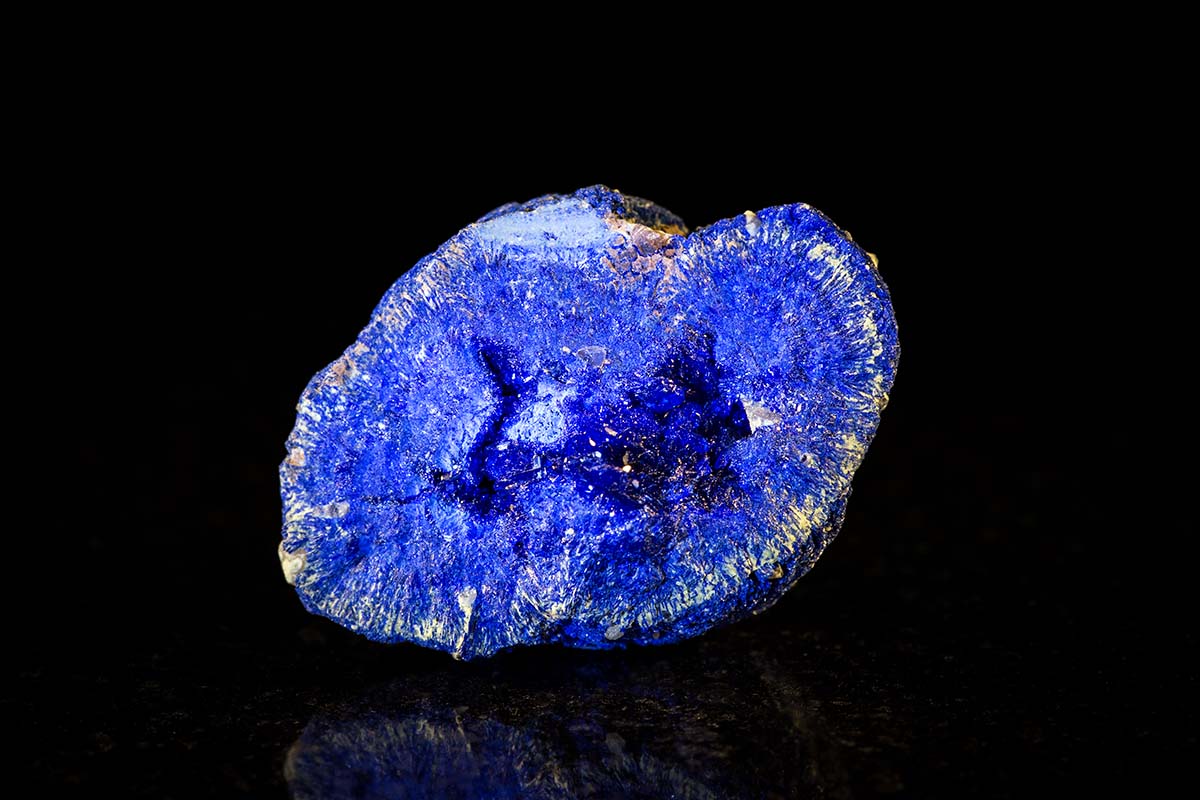
An ally of memory
Through its balancing action on the cells of the human body, azurite gathers the power of all micro-cellular memories. It then becomes a catalyst of memories by promoting synaptic connections and by activating the good health of memory.
A powerful anti-inflammatory
This mineral is commonly used in lithotherapy to combat inflammation and limit the harm caused by microbial activity. This anti-inflammatory effect is attributed to its high copper content.
Guardian angel of health
Azurite is regarded by lithotherapists as a valuable tool for identifying and analysing dysfunctions of the human body. It detects imbalances, explores the origins of ailments and makes it possible to generate a kind of holistic assessment. Through this preventive action, it acts as a stone that protects health.
A factor in post-operative healing
This stone brings a considerable source of energy in many contexts. Its use is particularly recommended in post-operative contexts. It provides the strength and optimism needed for an optimal convalescence.
Virtues of azurite against ailments of psychic and psychological origin
Activation of spiritual abilities
Azurite strengthens our link with the spiritual part present within us. It reveals the mysteries of intuition and brings us closer to our sensations. Through its action on the boundaries of our consciousness, this stone reveals our thoughts, purifies the mind and releases our blockages. It thus offers us a fresh vision of ourselves and of our life.
In connection with the divine
Lithotherapy attributes to azurite a potential for connection with the divine, lifting the veil on a form of telepathy. By drawing on the resources of this mineral, people drawn to the cosmos and in search of fundamental truths will embark on fascinating spiritual journeys.
Grounding and meditation
The azure stone brings us closer to our feelings and sensations. It helps us to find grounding and reach a meditative state. Meditation sessions, combined with azurite, are beneficial for both psychological and physical balance.
Release from phobias
Azurite is also a valuable element for fighting phobic phenomena. It brings automatic thought patterns to light and helps to detach from them in order to eliminate their harmful effects in terms of irrational fears.
Which stones should be combined with azurite?
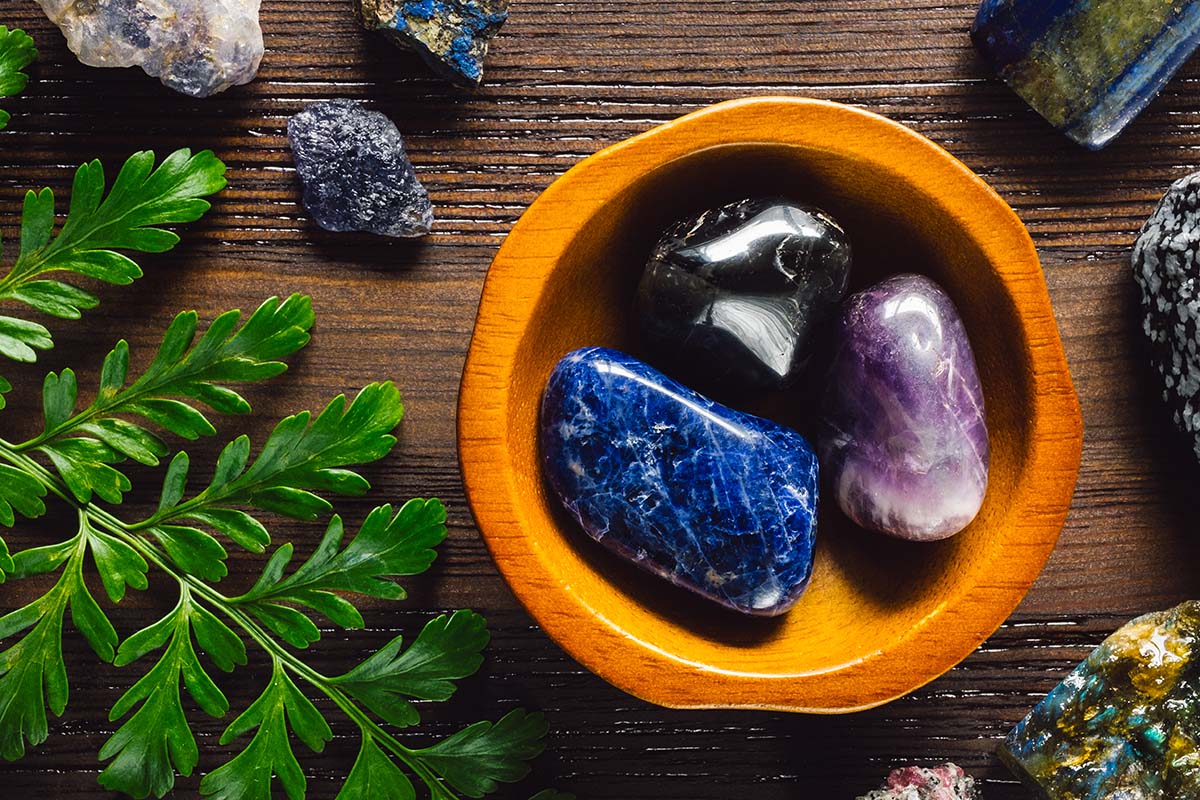
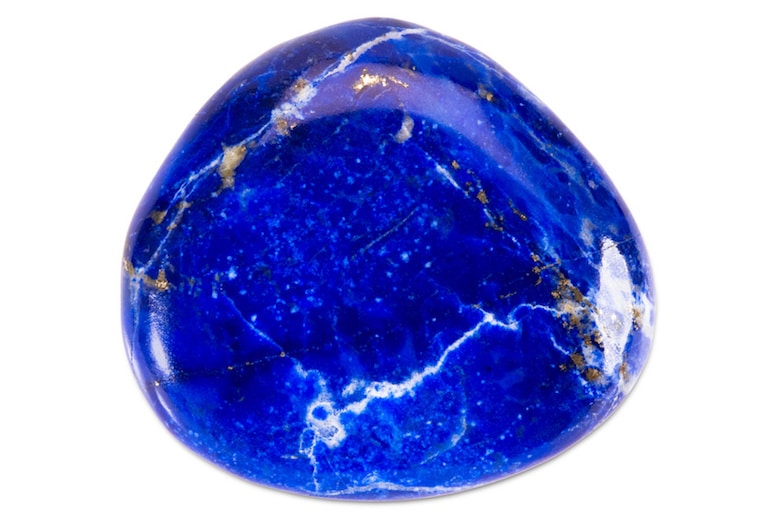
In the context of its impact on the third eye chakra, azurite pairs harmoniously with lapis lazuli or kyanite. The closeness of their energies and their colours reinforces their combined action.
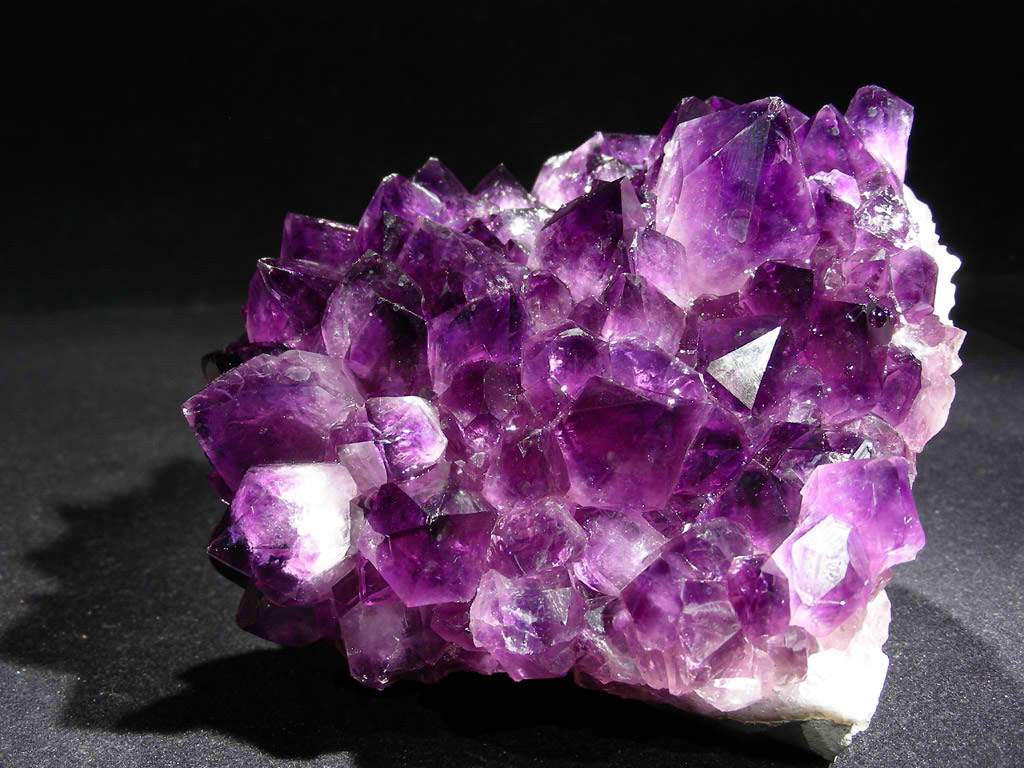
In the field of intuition, the properties of azurite combine with those of amethyst and labradorite in an exponential way. Chrysocolla can be recommended to accompany and magnify the vibrations of azurite. Finally, with a view to an inner journey, combining it with black tourmaline is a wise choice for guiding the mind.
How to cleanse and recharge azurite?
The stones used in lithotherapy benefit from being regularly recharged and cleansed. This is a way of giving them the care they need to intensify and target their vibratory power. In this way you can continue to enjoy all of their benefits.
With a composition close to that of malachite, it is best not to leave it in water for a prolonged time. You can nonetheless cleanse it by running it under running water for a few minutes, before drying it carefully. You can also use an alternative stone cleansing method, such as incense or salt.
To recharge your azurite, you can place it on a cluster of quartz, in the heart of an amethyst geode, or quite simply by exposing it to the natural light of the sun or the moon.






Leave a Reply