 English
  Français
 Español

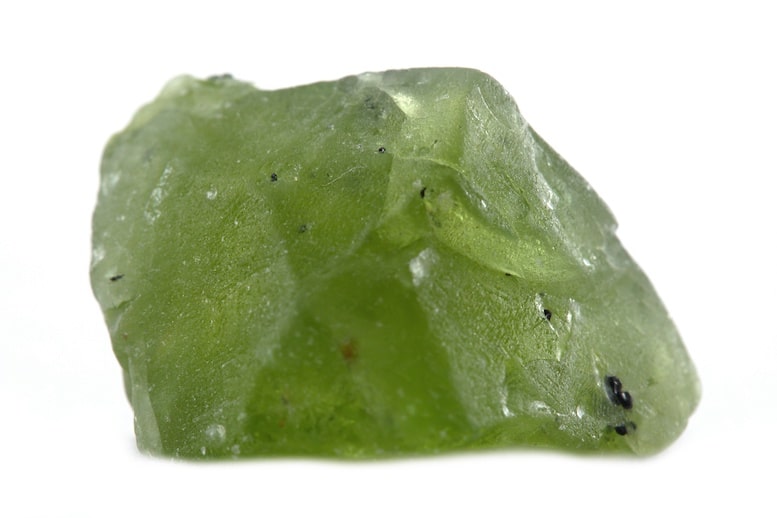
Peridot is a semi-precious gemstone that belongs to the olivine family. What sets it apart from other minerals is its green color and the range of shades it takes on, which depend on how much iron the stone contains. For as long as people have known this gem, its lively, varied greens have made it a favorite in jewelry and in crystal healing. It is also the traditional stone for a 16th wedding anniversary.
Several varieties of peridot are recognized, depending on color and origin. Chrysolite, also known as the “golden stone,” ranges from green to yellow-green and comes from volcanic rock. Olivine, as the name suggests, is olive-colored. Other peridots show deeper greens, some shading all the way into brown.
Mineralogical properties
In mineralogy, peridot is described using the following criteria:
| Group | Class VIII, silicates |
| Subgroup | Olivines |
| Crystal system | Orthorhombic |
| Chemical composition | Iron silicate with magnesium and manganese, also containing chlorine and nickel |
| Habit | Short prism |
| Fracture | Conchoidal |
| Luster | Vitreous, greasy |
| Streak | White |
| Density | 3.3 |
| Hardness | 6.5 to 7 out of 10 on the Mohs scale |
| Transparency | Transparent, translucent |
| Refractive index | 1.654 to 1.690 |
| Morphology | Crystals, granular and massive aggregates, grains |
| Magnetism | Paramagnetic |
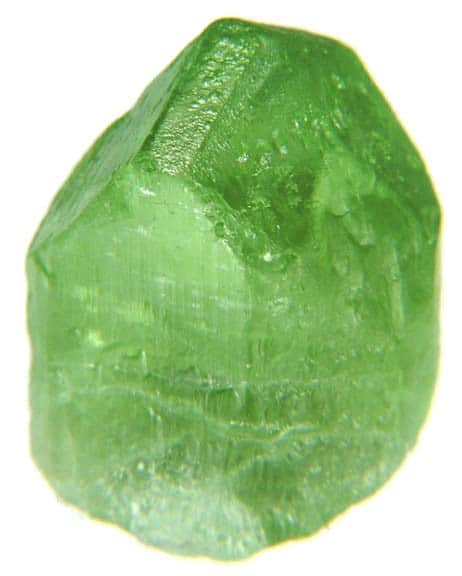
Individual peridot stones differ in hardness, density and luminescence. They form in igneous rocks and basic pegmatites, through contact metasomatism, and turn up in alluvial deposits and meteorites. Unlike most minerals, which form in the Earth’s crust, these gems come from the mantle: the movement of tectonic plates pushes them up to the surface from several kilometers down. The main peridot deposits are in the United States, China, Australia, South Africa and Brazil.
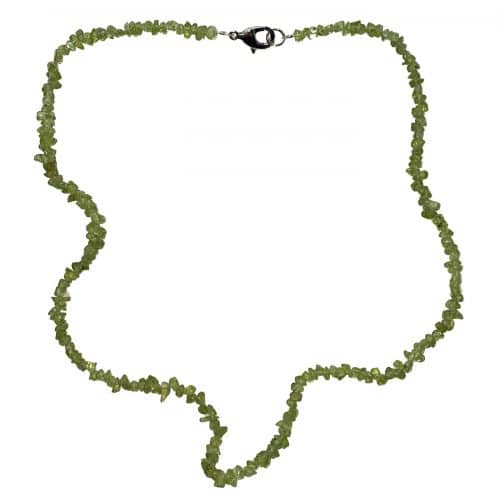
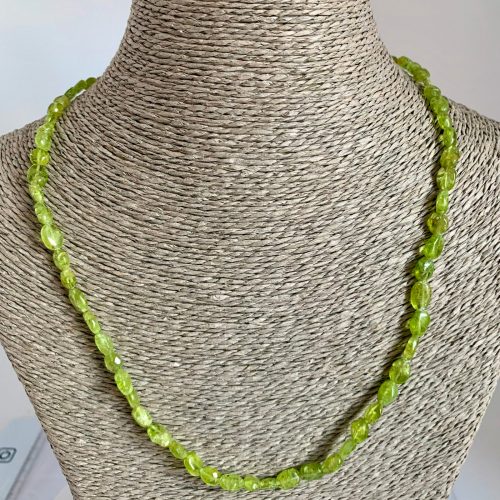
Peridot jewelry and objects
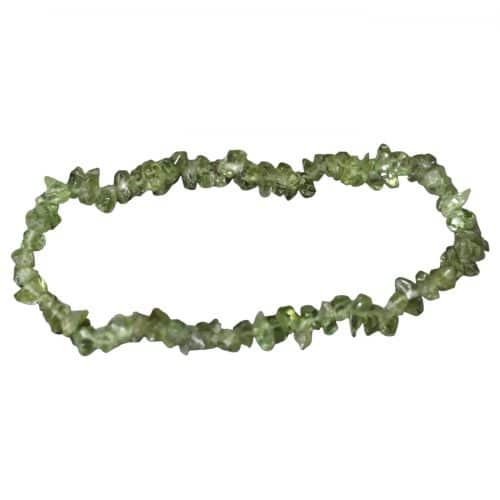
Etymology and meaning of the name peridot
The origins of the word peridot are somewhat murky. Etymologists have put forward two possibilities. The first traces it back to the Arabic “faridat,” meaning “precious stone.” The second connects it to the Latin “paederos,” which meant young boy and was also used for opal.
Peridot through history
Since antiquity
Peridot was probably first mined on the island of Zabargad, on the Egyptian side of the Red Sea, as early as 1500 BC. For years it was mistaken for emerald. The Egyptians, taken with its colors and its sparkle, tied it to divine light and called it the “stone of the sun.” That same sparkle made the deposits easy to spot at night, which helped miners mark out where to dig before extraction began.
In Greece, peridot was mostly worked into jewelry. The Ottoman sultans kept it for themselves, on the grounds that a stone this exceptional should not end up in just anyone’s hands. In the 12th century, Crusaders brought it into Central Europe, where it came to be called the “knights’ stone.”
A stone rich in symbolism
Then as now, peridot carries strong symbolic weight in cultures around the world. In the Maghreb it stands for brotherhood, joy and luck, and it is presented as an offering at certain ceremonies, particularly those connected with the invisible world. In Israel it represents the spirit of the Divine, along with glory, power and authority. Christians see it in a similar light: for them the gem is tied to the Holy Spirit and to the beginning and end of life on Earth. According to the Bible, it may well have been one of the twelve stones set into Aaron’s breastplate.
After the Crusades, peridot also turned up as ornamentation in a number of churches. In Cologne Cathedral, for example, the Shrine of the Three Kings is itself crowned with a large peridot. Alchemists, for their part, credited the stone with centering, purifying and protective powers. In Hawaii it represents the tears of the goddess Pele. Olivine, meanwhile, is associated with the nourishing and cleansing qualities of olive oil.
A valuable mineral
Today, 90% of the peridot mined for jewelry comes from the San Carlos Apache Reservation in Arizona. The clearest and brightest stones come from a region of Kashmir. Peridot is also found in Australia, Brazil and China.
Finally, some stones are thought to come from meteorite fragments, born in the asteroid belt drifting between Mars and Jupiter. When it comes from a meteorite, peridot goes by the name palladot.
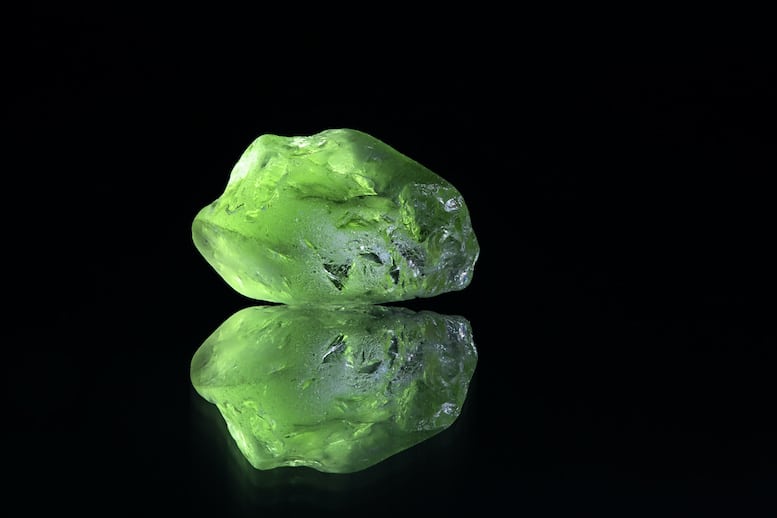
Virtues and powers of peridot in crystal healing
Crystal healing turns to peridot for its benefits on both the physical and the mental level. Its blazing green color is associated with the heart chakra, and the stone is credited in particular with an action on the entire cardiovascular system. On the emotional and mental side, this mineral helps dissolve negative emotions. It can be used in several ways to that end.
Peridot’s virtues against physical ailments
Cardiovascular system
By acting directly on the heart, peridot has a strong influence over certain organs and bodily functions. It is said to help regulate body temperature and blood circulation.
Digestive system
This stone works especially on organs such as the liver, the gallbladder and the intestines, supporting their regulation and good health. Peridot can also aid weight loss by stimulating the elimination of fat. It eases transit and digestion as well.
Pain and inflammation
Peridot has the power to ease pain and to make labor easier by encouraging contractions. It may also act on certain inflammatory conditions.
Respiratory effects
Peridot is known to have a beneficial effect on coughs.
Skin benefits
On the skin, this mineral beautifies, regenerates and soothes. It also helps wounds heal and calms insect bites.
Vitality
Taken as a whole, peridot helps revive and boost the body’s vital energy. It supports detoxification too.
Mental, emotional and spiritual virtues
Accepting yourself and others
Peridot gives self-confidence a boost. It lowers stress and eases feelings of jealousy, sadness and anger, making room for fresh, positive energy. The result is a stronger mind, greater self-acceptance and a more open outlook.
Abundance
This gem encourages financial prosperity and good luck in every area of life. It favors happy marriages, romantic unions and relationships in general.
Intuition and clairvoyance
Peridot acts on the third eye, which helps develop clairvoyance and intuition.
Protection
It is also said to protect against entities and evil spirits, especially at night. It promotes better sleep and can ward off curses.
A stone of light
Peridot dissolves negative feelings tied to past events and lets its wearer’s divine power come through. It makes way for purity. Its action on the body’s energy centers encourages love of self and others, joy and creativity.
How to use peridot
Depending on its form (tumbled stone, sphere, jewelry, and so on), peridot can be used in several ways. You can wear it as jewelry (bracelet, necklace, pendant, ring), for instance, or hold it under your tongue to let its energies spread.
Its energies are multiplied when it comes into contact with gold or a quartz. Placed in a room, it can act on the room’s vibrations. Apart from these stones, it is best to keep peridot away from other minerals, since the interaction would weaken its benefits.
Peridot can also be laid on a painful spot on the body (the belly, in particular) to relieve discomfort. It works in massage too, especially slimming massages. Steeped in water, it has a beneficial effect on skin problems.
Every zodiac sign can enjoy the benefits of this stone. That said, peridot seems especially well suited to Leo, Libra, Capricorn, Taurus and Aries.
Cleansing and recharging peridot
Every stone needs to be cleansed and recharged regularly to keep delivering its benefits properly. So make a habit of purifying your peridot. All it takes is a rinse in distilled water.
Once purified, the mineral can be recharged with energy. Leave it out in sunlight for several hours, or set it on a quartz cluster or an amethyst geode. Either one will recharge peridot and amplify its energies.






Leave a Reply