 English
  Français
 Español

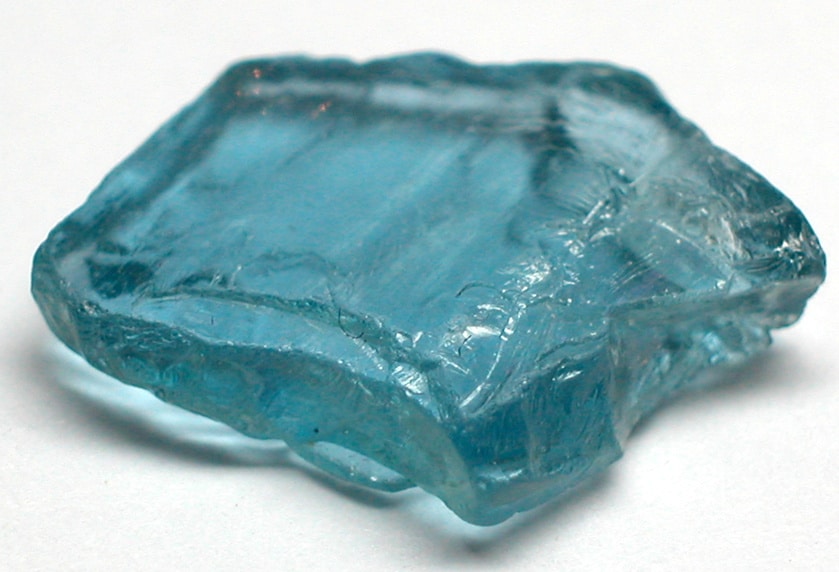
Long ago, people imagined it rising from the waves like an offering left by the gods of the ocean, Poseidon, Triton and the other Nereids. The reality is even more magical than the myth because aquamarines the colour of waves are born deep within the Earth. Some of the most beautiful ones are found at the very roof of the world: the Himalayas. In Pakistan, the ancients called the almost inaccessible mines of Chumar-Bakar “the realm of the fairies“.
Aquamarine, as refreshing as clear water, comes to us from the furnaces of our planet. Its pretty name was given to it in the 16th century; before that it was called “beryl” like so many other stones. Its colour, however, drew attention and gave it a distinction all its own. “The finest beryls are those that mimic the colour of seawater“, wrote Pliny in the 1st century AD.
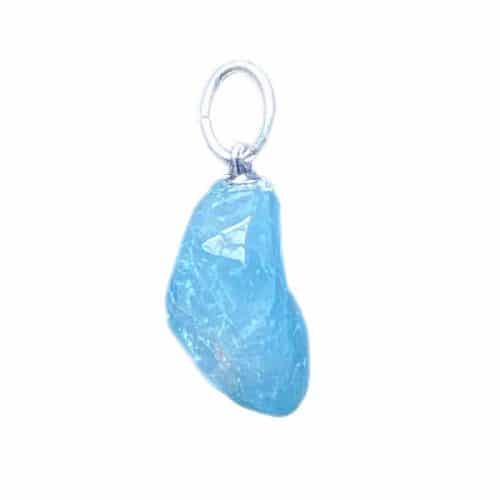
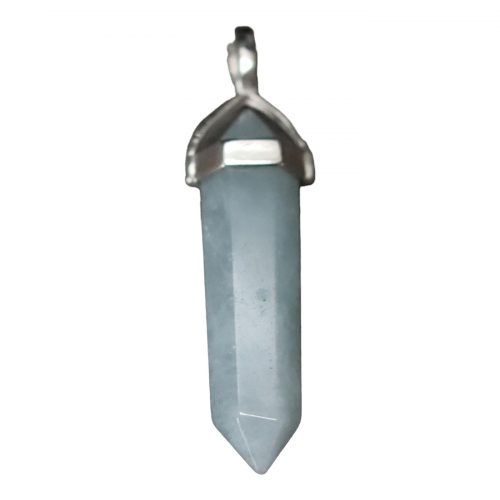
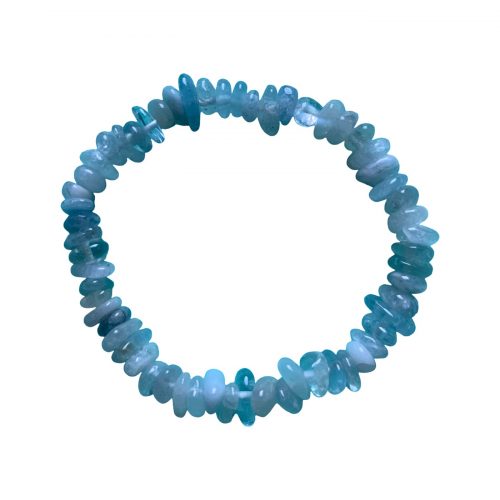
Aquamarine jewellery and objects

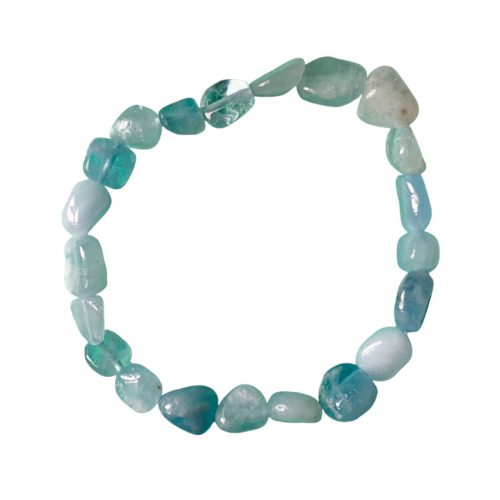
Mineralogical characteristics

Aquamarine, composed of silica, aluminium, copper, beryllium and iron, belongs to the cyclosilicates. Its hardness is 7.5/8 on a scale of 10. It has a fine lustre and can range from transparent to translucent.
Aquamarine belongs to the beryl family, which also includes the precious emerald and three other, far more common minerals: colourless goshenite, pink-toned morganite and yellow heliodor.
Iron, more or less oxidised, gives aquamarine its colour, blue or green and in various light or dark shades. On very rare occasions it may display tiny mineral inclusions that produce a chatoyant effect or a star. The dark blue “deep lagoon” hue is currently the most sought-after. To obtain it, artificial methods with unstable results are frequently used: heating stones deemed too pale or greenish to 450°, or irradiation with neutrons and gamma rays.
The most important and renowned deposits are found in Brazil and Pakistan. The other extraction sites are located in Australia, in Asia (Burma, China, India, Sri Lanka), in Africa (Kenya, Madagascar, Mozambique, Namibia, Nigeria, Tanzania, Zambia, Zimbabwe), in the United States and in Russia. In France, deposits are found at Chanteloube (Limousin), Échassières (Auvergne) and La Villeder (Brittany).
Aquamarine is a minor constituent of granitic and pegmatitic rocks, and is also found in alluvial deposits. Aquamarine is sometimes accompanied by other minerals: lepidolite, spessartite, or by its cousins, morganite and heliodor. In Pakistan, it is sometimes found on muscovite.

It can be confused with: kyanite, euclase, apatite or topaz and blue tourmaline. The name aquamarine is sometimes linked to erroneous or misleading appellations such as: “oriental aquamarine”, “Brazilian aquamarine”, “Siam aquamarine”, and even “synthetic aquamarine”, which is generally a synthetic spinel.
Aquamarine mining and famous stones
Extracting very large crystals is possible, but these are often opaque specimens of an unappealing greyish hue that are unsuitable for jewellery. Beauty is not the only thing that makes aquamarine of interest. One of the metals in its composition, beryllium, has properties much sought after in industry. This low-density element, rare and resistant, is used in aeronautics and in nuclear energy.
The Santa Maria appellation (named after a Brazilian mine) is reserved for the finest aquamarines. The even more sought-after Santa Maria Maxixe is a deep blue aquamarine that fades in the light.
The largest gem-quality stone, weighing 110 kg, was discovered in 1910 at Marambaia in Minas Gerais, Brazil. Numerous gems were cut from it for a total weight of 100,000 carats. In the same region, at the Pedra Azul deposit, deep blue aquamarines with curiously rugged reliefs have been extracted since 1957.
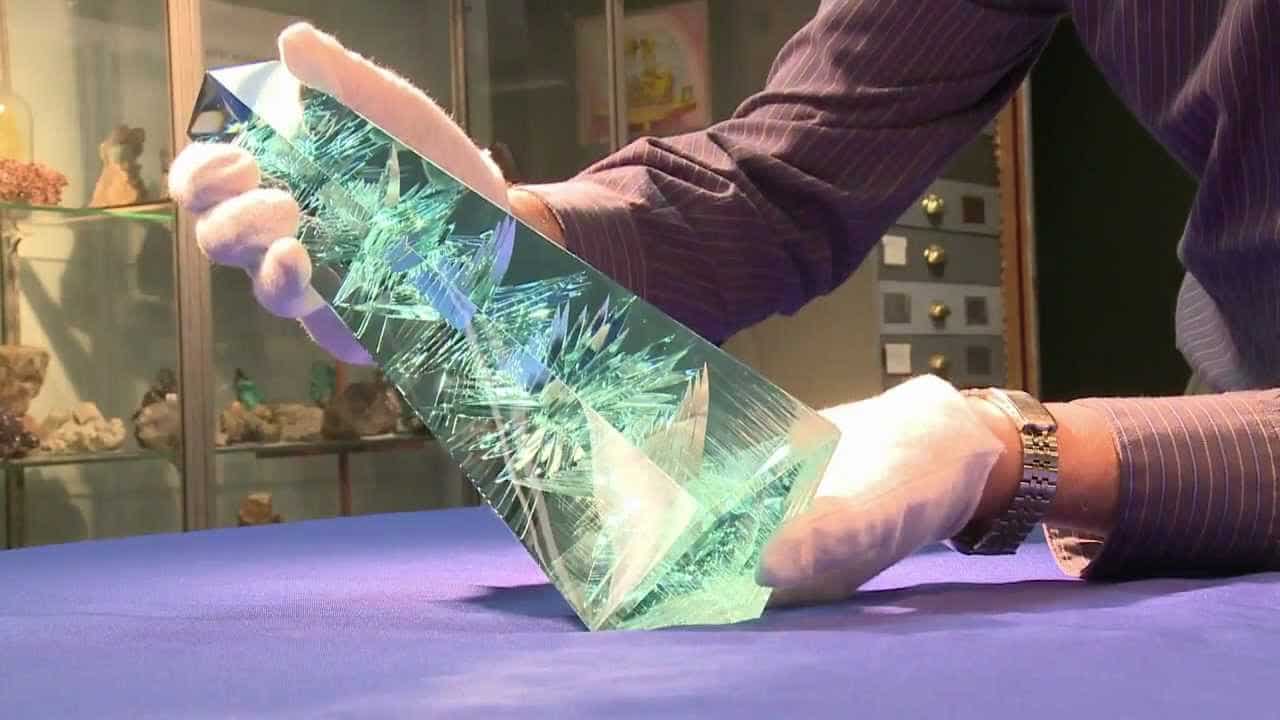
The most famous Brazilian aquamarine is named Dom Pedro. Of an incredible azure clarity, this 2 kg stone is the largest cut aquamarine. The crystalline obelisk has been on display since 2012 at the Natural History Museum in Washington, the Smithsonian Institution. Dom Pedro stands alongside another wonder, the Hope Diamond, cut from the famous “blue diamond”, a jewel of the French Crown acquired by Louis XIV.
Pakistani aquamarines have long been recognised as being among the most beautiful. The extreme conditions of extraction and transport limit their acquisition and display in the West. Nevertheless, collector specimens have appeared regularly over the past few decades; one well-known example is the “Manhat Tan”, with its curious geometric shapes.
Etymology and meaning of the word “aquamarine”
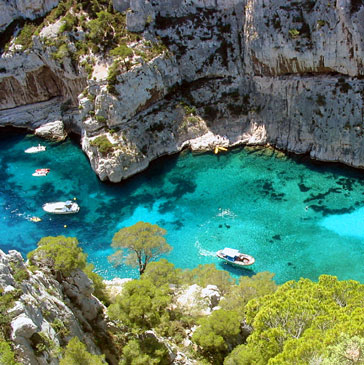
“Aigue-marine” is the langue d’oc form (Occitan, Provençal) of the Latin aqua marina, which literally means “seawater”. The Occitan root aiga, aigue (water) survives in the word aiguière, a kind of medieval ewer, and in the name of the town in the Gard department: Aigues-Mortes (dead waters).
The term “aquamarine” first referred to the colour (seawater) of the stone. People thus spoke of “aquamarine beryl”. It was not until the 16th century that the scholar Blaise de Vigenère definitively named this stone “an aquamarine”.
It is worth noting that the English form of the word has stayed very close to the original Latin form “aqua marina“. In English, “aigue-marine” is thus written “aquamarine“, as a single word.
Aquamarine through history
Aquamarine in Antiquity
It is not always easy to trace the history of aquamarine in Antiquity, because confusions sometimes arise. The Egyptians, the Greeks and the Romans knew how to tell the difference between an emerald, a sapphire and an aquamarine. The Romans called chrysocollas “angites” or “callais” and aquamarines “beryls”.
In ancient Egypt, aquamarine, called “zeberdjed“, was mined in the same mines as the emerald (“zemroud“), in the vicinity of Aswan on Mount Zabarah. Their colours range from a deep green to a very pale green and show an almost perfect limpidity. Far less prized than emeralds, aquamarines were nonetheless frequently associated with them.
The hardness of aquamarines lends itself to the art of the intaglio (incised engraving), which was commonly practised in Egypt, Greece and above all in Rome, where the engraving of emeralds was forbidden. Artists signed their works: thus Quintillius fashioned a Neptune mounted on sea-horses, and Hyllus depicted a drinking Hercules on an aquamarine destined for the cruel emperor Commodus (2nd century AD).
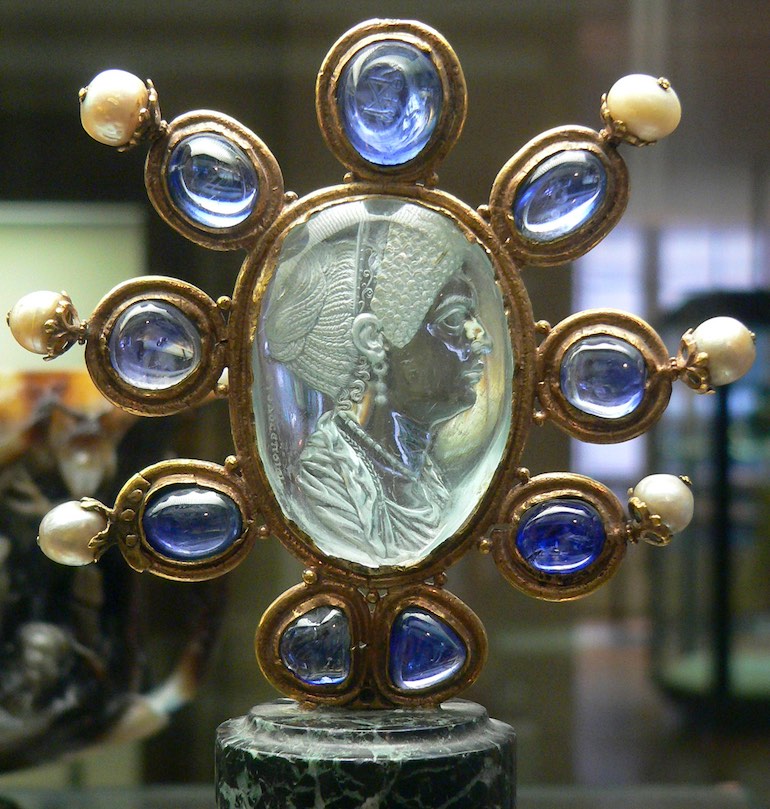
The most famous of these engravings remains the intaglio of Julia, made in the 1st century AD by the Greek sculptor Evodos. It depicts the daughter of the emperor Titus. This magnificent aquamarine measures 5 cm in height by 4 cm in width; very clear and transparent, it is one of the finest antique gems to have come down to us.
Aquamarine in the Middle Ages
In the Middle Ages, the intaglio was set into a sumptuous piece of jewellery. The whole took the name Escrain (casket) of Charlemagne; his grandson, King Charles the Bald, gave it to the royal abbey of Saint-Denis. The portrait of Julia, surrounded by sapphires and pearls, crowned a golden framework covered with precious stones. This masterpiece of Carolingian goldsmithing has unfortunately been lost; all that remains are a few engravings and the pinnacle of the treasure: the antique engraved aquamarine framed by medieval jewels. The intaglio of Julia is thus preserved in the Cabinet des Médailles of the Bibliothèque Nationale in Paris.
In the 13th century, the grimoire entitled “The Admirable Secrets of Albertus Magnus” is attributed, perhaps wrongly, to the Dominican friar Albertus Magnus, the famous naturalist. The author may well have seen the intaglio of Julia, for his description of aquamarine bears a striking resemblance to it: “of a pale colour and transparent like water…“. He adds: “with it (the beryl), one fears no enemy and wins every lawsuit. It also makes children studious and intelligent“. This book, describing the “magical virtues of minerals”, was hugely successful for centuries.
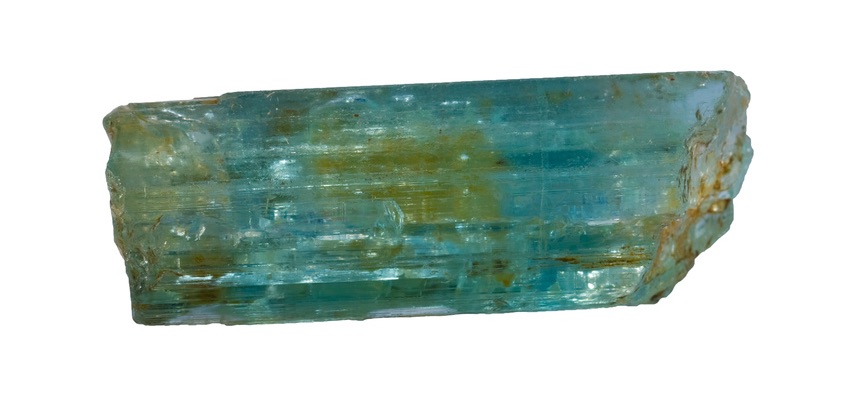
Aquamarine is therefore said to have beneficial effects, most often linked to the transparency of water and to the sea. With it, everything becomes clear: eyesight, ideas and the future too, since aquamarine crystal balls are highly prized in fortune-telling. But these are not the only properties attributed to aquamarine… What are the benefits and virtues that lithotherapy attributes to this beautiful blue crystal?
The virtues of aquamarine in lithotherapy
Aquamarine is a soothing stone; it strengthens budding love (it is frequently given as an engagement ring) and reinforces the love of established couples. Its calm sea colour has always dedicated it to smooth sea voyages. It is the stone of sailors, whom it protects from drowning, and of all navigators.
Aquamarine aligns all the chakras. It is more particularly associated with the heart chakra and the throat chakra, which it helps to purify. It is said to be the stone of Libra, for whom it is a lucky stone. But it is also associated with the astrological signs of Aquarius, Pisces and Gemini.
The benefits of aquamarine against physical ailments

On the physical level, aquamarine is reputed for its ability to strengthen the immune system, and it has a general tonic effect. It harmonises the functioning of the endocrine glands (thyroid, pituitary…), is beneficial to the lymph and strengthens the immune system in general. It soothes eye strain and calms toothaches.
Heart, high blood pressure and blood disorders
Aquamarine is reputed for its ability to regulate the heart rhythm and for its beneficial effects on the circulatory system. It is recommended in cases of high blood pressure, blood disorders and to strengthen the heart in general.
Motion sickness and nausea
A stone that protects travellers, aquamarine relieves motion sickness. It is particularly recommended for seasickness. More generally, it helps to soothe nausea.
Respiratory system, throat, vocal cords and larynx
Aquamarine has a favourable influence on the whole respiratory system. It is indicated in cases of respiratory tract infection, sore throat, bronchitis and cough. It is beneficial to the tonsils, the larynx and the throat, and strengthens the vocal cords. It also helps to relieve allergic conditions: hay fever, sinusitis.
Skin allergies and rashes
Aquamarine helps to calm skin conditions: eczema, psoriasis and acne. If you suffer from skin allergies, you can make an aquamarine elixir. Leave your stone to soak in a glass of water overnight. Apply the lotion several times a day without rubbing (keep refrigerated for one week).
The benefits of aquamarine on the mind and relationships

The gentle, restful vibrations of aquamarine encourage communication and tenderness and develop sensitivity. It favours artistic professions, brings inspiration and eloquence, and increases the capacity for expression.
Anxiety and worry
Its soothing vibrations help to calm anxiety, as well as nervous and emotional tension, making way for inner peace. It is also recommended for people prone to bouts of anxiety.
Intellect
Aquamarine is beneficial to the brain and helps keep the mind young. It sharpens the intellect, clarifies perception and favours study. It stimulates lucid, clear-sighted thinking. It is particularly recommended in situations involving an oral exam.
Courage and communication
Aquamarine encourages communication, tolerance and tenderness, and heightens the sense of responsibility. It is also a stone reputed for the courage it provides. It reduces stress. For these reasons, it is particularly recommended in situations involving an oral exam.
Which stones should be combined with aquamarine?
Like other healing minerals, aquamarine can be combined with other stones to maximise its effects. Its gentle, soothing energy pairs well with lapis lazuli, turquoise, amazonite, larimar or jade.
Cleansing and recharging
Aquamarine is cleansed under running water or by immersing it in a glass or earthenware container filled with distilled or salt water. You can also cleanse it with incense. It recharges simply in the sun or on a cluster of crystals.




Leave a Reply