 English
  Français
 Español

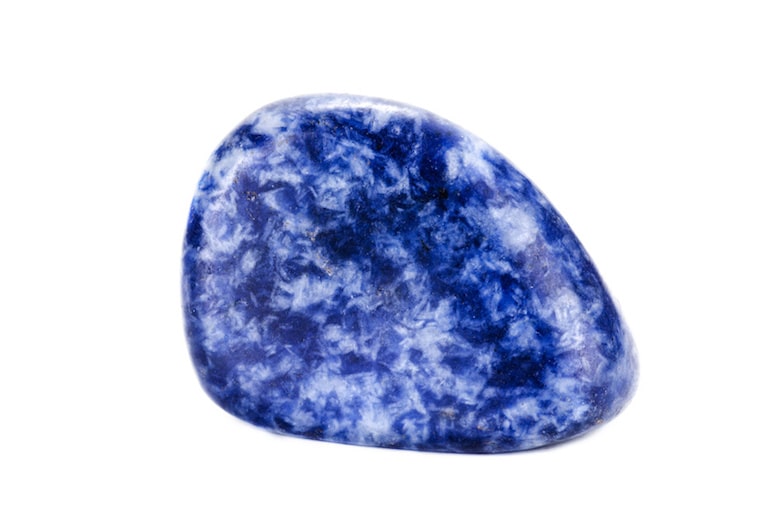
Deep blue veined with white, sodalite has the charm of a soft, snowy night yet it tends to get looked down on a little: people often treat it as the poor relation of the magnificent lapis lazuli, whose ancient history still dazzles us. Sodalite is, admittedly, the quieter of the two. It can still surprise you, and sometimes hides some marvelous powers.
Mineralogical characteristics of sodalite
Within the large silicate group, sodalite belongs to the feldspathoid tectosilicates. This is a subgroup close to the feldspars but with different physical and chemical properties: their low silica content makes them much less dense minerals. Aluminum is abundant in their composition, hence the scientific label “aluminosilicate”. Sodalite also stands out for a very high sodium content, along with chlorine.
Sodalite is part of the “ultramarine” family. The name recalls where lapis lazuli came from: beyond the Mediterranean. Lapis lazuli is itself a blend of several minerals. Its main component is lazurite, also classed among the ultramarines, sometimes accompanied by similar minerals such as haüyne and sodalite. Calcite and pyrite go into the mix too. Pyrite, which gives lapis lazuli its golden flecks, is very rarely found in sodalite.
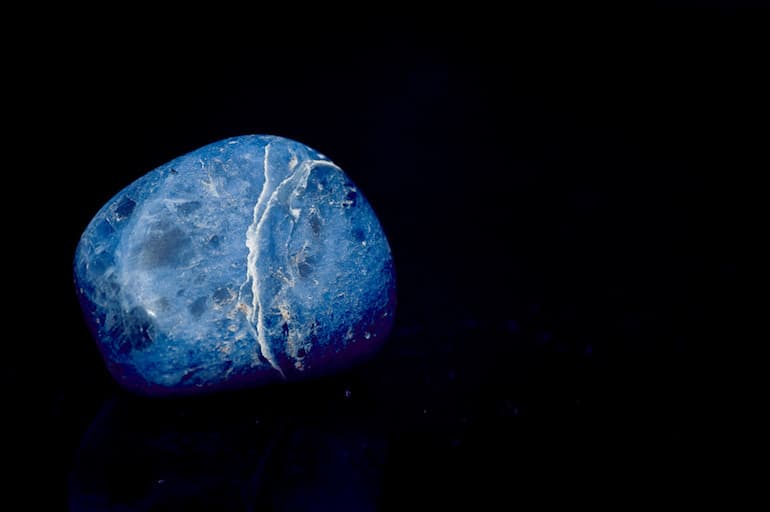
Sodalite occurs in silica-poor rock environments of volcanic origin: in igneous rocks such as syenite, or in the material thrown out by volcanoes during eruptions. It has also been found in meteorites. Most often it appears as isolated grains within the rock or as massive aggregates, and fairly rarely as separate crystals.
The colors of sodalite
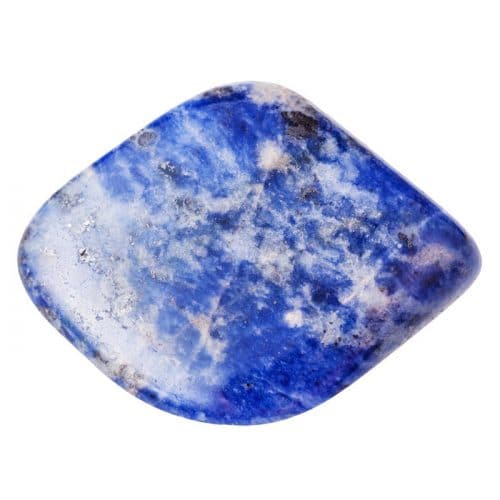
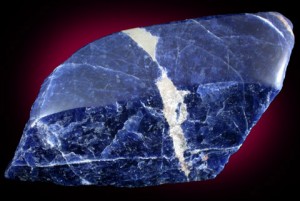
Ornamental stones, figurines and gems cut as cabochons or faceted are most often light blue to midnight blue, frequently veined with white calcite that gives them a cloudy or threadlike look. Sodalite can also be white, pink, yellowish, greenish or reddish, and more rarely colorless.
Where sodalite comes from
Sodalite is quarried in the following countries and regions:
- Canada, Ontario: Bancroft, Dungannon, Hastings. Quebec: Mont Saint-Hilaire.
- United States: Maine, Montana, New Hampshire, Arkansas.
- Brazil, state of Bahia: the blue quarries of Fazenda Hiassu at Itaju do Colônia.
- Russia: the Kola Peninsula, east of Finland, and the Urals.
- Afghanistan, Badakhshan Province (hackmanite).
- Myanmar (Burma), around Mogok (hackmanite).
- India, state of Madhya Pradesh.
- Pakistan (rare crystals with pyrite).
- Tasmania
- Australia
- Namibia (transparent crystals).
- Western Germany, the Eifel mountains.
- Denmark, southern Greenland: Ilímaussaq
- Italy, Campania: the Somma-Vesuvius complex
- France, Cantal: Menet.
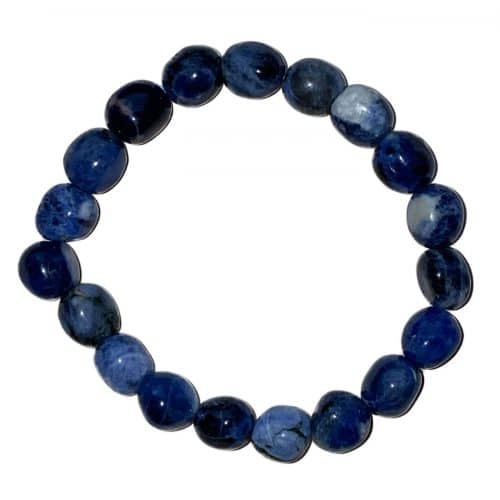
Jewelry and objects made of sodalite


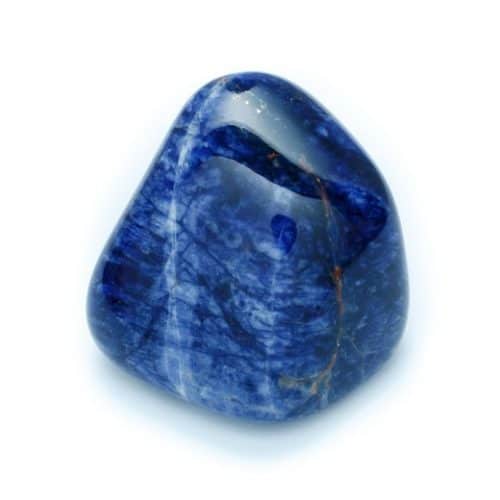
The tenebrescence of sodalite
Sodalite displays a rare luminescence phenomenon called tenebrescence, or reversible photochromism. It is even more striking in a pink variety named hackmanite, after the Finnish mineralogist Victor Hackman. Afghan hackmanite is pale pink in ordinary light but turns an intense pink in bright sunlight or under an ultraviolet lamp.
Put back in the dark, it keeps that same glow for anywhere from a few moments to a few days, thanks to phosphorescence. Then the spectacular color drains away, like a rose wilting. The same specimen will do it again every time you repeat the experiment.
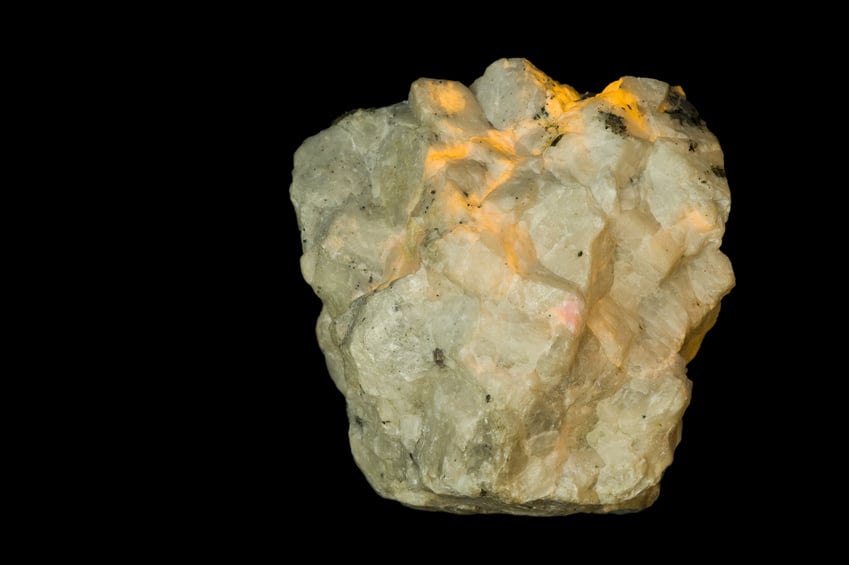
The reverse happens with hackmanite from Mont Saint-Hilaire in Canada: its lovely pink turns greenish under UV. Some sodalites from India or Myanmar go orange, then take on mauve glints once the lamps are switched off.
The mineral’s atoms absorb the ultraviolet rays and then give them back in this surprising way. The effect feels almost magical and is very hit-or-miss: some sodalites show it, while others that look identical and come from the very same spot never will.
Other sodalites
- Sodalite is sometimes called “alomite“, after Charles Allom, a major quarry owner at Bancroft, Canada, in the early 20th century.
- Ditroite is a rock made up of sodalite among other things, which makes it very rich in sodium. It owes its name to where it was found: Ditró, in Romania.
- Molybdosodalite is an Italian sodalite containing molybdenum oxide (molybdenum being a metal used in metallurgy).
- Synthetic sodalite has been on the market since 1975.
Etymology of the word “sodalite”
In 1811, Thomas Thomson of the Royal Society of Edinburgh gave sodalite its name and published his scientific paper:
“No mineral has so far been found that contains as much soda as the one which is the subject of this paper; that is the reason I have adopted the name by which I designate it…”
The name sodalite is thus made of “soda” (the old word for sodium carbonate) and “lite” (from lithos, the Greek word for stone or rock). The word soda comes from the medieval Latin soda, itself derived from the Arabic suwwad, a plant whose ashes were used to make soda. As for the fizzy drink, and this is just an aside, “soda” is short for “soda-water“.
The history of sodalite
Antiquity
Sodalite was discovered and described in the early 19th century. That doesn’t mean nobody knew it before then. The lapis lazuli of antiquity, used in great quantities by the Egyptians and other Mediterranean civilizations, came from the mines of Badakhshan in Afghanistan, where sodalite is still extracted today.
Sodalite was probably not especially sought after, since ancient texts never mention it. Pliny the Elder describes only two blue stones. One is the sapphirus with little golden spots, which surely refers to lapis lazuli and its pyrite inclusions. The other is the cyanus, the color of the sky, which would be the sapphire.
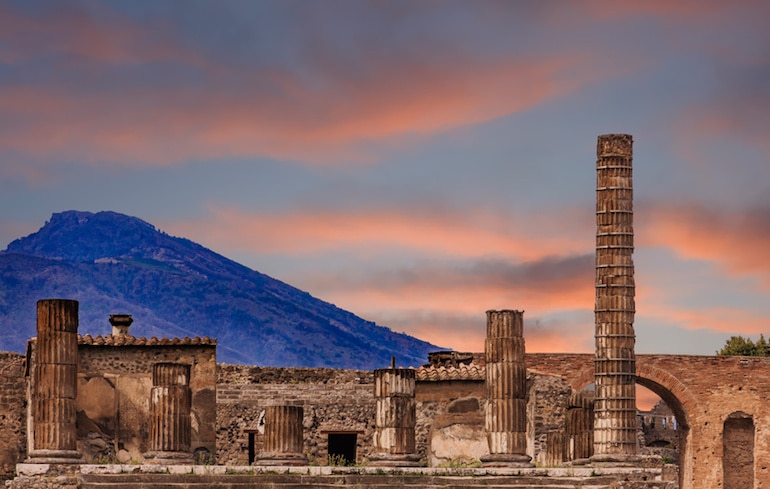
And yet the Romans knew one variety of sodalite very well, though its color is no remarkable blue. It is often grayish or greenish, and sometimes remarkably clear. This is the sodalite of Vesuvius. Some 17,000 years ago the “mother” volcano, Monte Somma, collapsed and gave birth to Vesuvius. The sodalite found in the lava Vesuvius spews out comes from that great upheaval.
The eruption of Vesuvius in 79 AD, which buried Pompeii and Herculaneum, proved fatal to Pliny the Elder. The naturalist and writer, a victim of his own tireless curiosity, died for having gone too close to the volcano, and so shared the fate of thousands of others.
In the 19th century, granular sodalites identical to those of Vesuvius were discovered on the shores of Lake Albano, just outside Rome. The mountain ringing the lake is almost certainly an old volcano. Tarquin the Proud, the last king of Rome, had a temple to Jupiter built on its summit around 500 BC. A few ruins remain, but Mount Albano holds other memories as well: the place is strewn with volcanic minerals.
Livy, a Roman historian of the 1st century AD, reports an event said to have taken place long before his time, and it does seem to hint at sodalite: “the earth opened up at that spot into a horrible chasm. Stones fell from the sky like rain, and the lake flooded the whole countryside…“
Pre-Columbian civilizations
Around 2000 BC, the Caral civilization of northern Peru was using sodalite in its rituals. Offerings made up of sodalite fragments, quartz and unfired clay figurines have been found at the archaeological site.
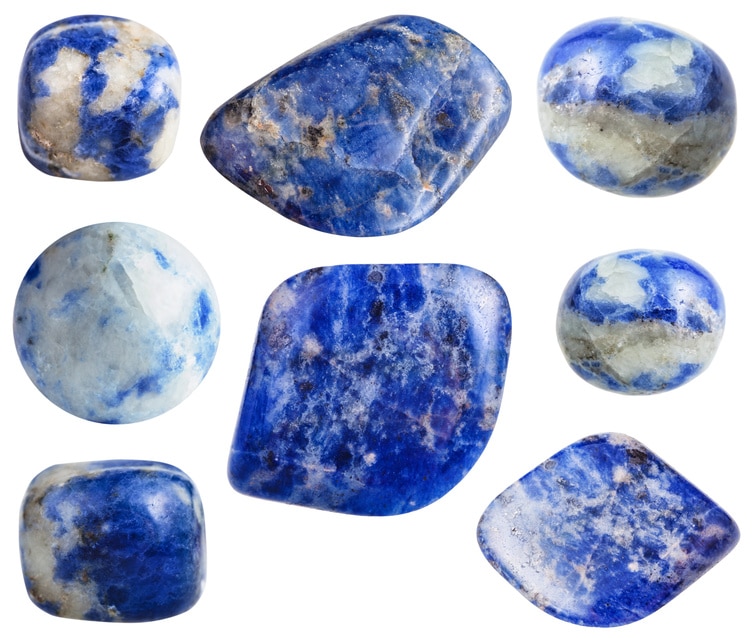
Much later (from the 1st century to about 800 AD), the Moche civilization left behind astonishing gold jewelry in which sodalite, turquoise and chrysocolla form tiny mosaics. At the Larco Museum in Lima you can see ear ornaments showing warrior birds against shades of blue. Others alternate tiny lizards in gold and in sodalite.
The Middle Ages and the Renaissance
From the 14th century onward, lazurite began to be extracted from lapis lazuli and turned into ultramarine blue pigment. The translucent blue of sodalite can’t be worked that way, so it was useless for the purpose. Sodalite kept a very low profile in this period.
The modern era
In 1806, Karl Ludwig Giesecke, a mineralogist in the service of Denmark, brought back various minerals from a trip to Greenland, among them the future sodalite. A few years later Thomas Thomson also got hold of samples of the mineral, analyzed it and gave it its name.
Around the same time, the Polish count Stanisław Dunin-Borkowski was studying the sodalite of Vesuvius that he had picked up on the slope known as Fosso Grande. He dipped fragments of this very clear stone in nitric acid and noticed a white crust forming on their surface. Ground to powder, sodalite turns to gel in acids.
Once the analyses and experiments were compared, the Greenland stone and the Vesuvius stone were declared to be one and the same species.
 Canadian sodalite
In 1901, Mary, Princess of Wales and wife of the future George V, visited the World’s Fair in Buffalo and took a particular liking to the sodalite from Bancroft, Canada’s mineral capital. Some 130 metric tons of rock were then shipped to England to decorate the royal residence of Marlborough House (today the headquarters of the Commonwealth Secretariat). Ever since, the Bancroft sodalite quarries have gone by the name “Princess Sodalite Mine”.
Sodalite’s nickname, “Princess Blue”, seems to have been a tribute to another member of the British royal family of the day: Princess Patricia, a granddaughter of Queen Victoria who was hugely popular in Canada. From then on blue sodalite came into fashion. Watchmakers, for one, often used it for the dials of luxury watches.
The Bancroft quarries have been open to the public since 1961. The “Rock Farm” is the friendliest corner of the site. Much like the pick-your-own fruit and vegetable farms, it lets anyone gather sodalite for a reasonable price by weight. You choose and dig out your own treasures: small specimens for a collection, or big chunks to decorate the garden. The bucket is provided. The only requirement is a good pair of closed-toe shoes!
The virtues of sodalite in crystal healing
In the Middle Ages, sodanum, probably extracted from a plant, was a soda-based remedy for headaches. Crystal healing finds that same soothing effect in sodalite. It helps lighten the mind and eases tension and needless feelings of guilt. By keeping sorrows at bay it encourages meditation and, in harmony, satisfies our search for an ideal and our thirst for truth.
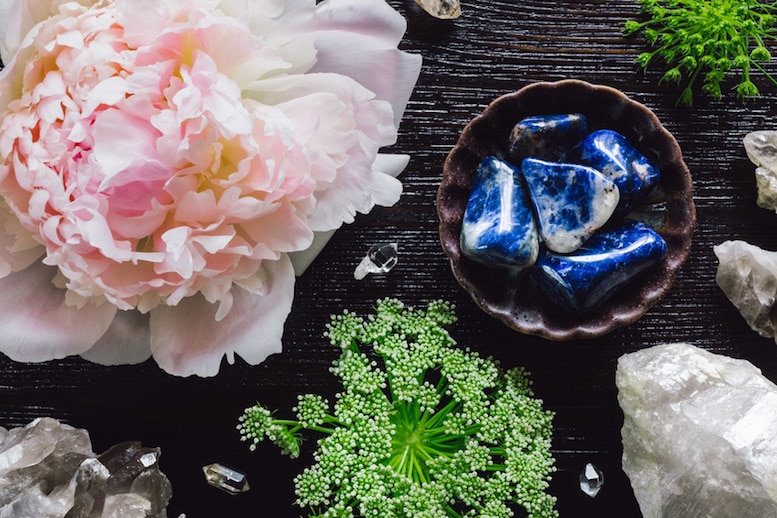
Benefits of sodalite for physical ailments
- Stimulates brain function
- Balances blood pressure
- Regulates endocrine balance: a positive effect on the thyroid, insulin production…
- Eases calcium deficiencies (spasmophilia)
- Calms panic attacks and phobias
- Helps babies sleep
- Relieves stress in pets
- Soothes digestive troubles
- Relieves hoarseness
- Boosts vitality
- Helps in the fight against diabetes
- Neutralizes electromagnetic pollution
Benefits of sodalite for the mind and relationships
- Brings order to logical thinking
- Aids concentration and meditation
- Helps keep emotions and oversensitivity in check
- Improves elocution
- Encourages self-knowledge
- Restores humility or, conversely, lifts feelings of inferiority
- Makes group work easier
- Develops solidarity and altruism
- Strengthens loyalty to one’s convictions
Sodalite is linked first and foremost to the 6th chakra, the third eye chakra (the seat of consciousness).
Cleansing and recharging sodalite
Spring water, demineralized water or simply tap water will suit it perfectly. Avoid salt, or use it only very occasionally.
For recharging, no sun: moonlight is the better choice for recharging sodalite, or place it inside an amethyst geode.






Leave a Reply