 English
  Français
 Español


The tiger, a powerful big cat with a coppery golden gaze, lends its name to this fascinating mineral. Despite its wild appearance, tiger’s eye is reputed to be protective and beneficial. A warm stone above all others, tiger’s eye is credited with the power to repel all dangers, even those of the night, in the manner of the fires once lit to keep unwanted beasts at bay.
Tiger’s eye is shrouded in mystery, and its identification remained rather vague in the West for a very long time. At the beginning of the 19th century, the discovery of large deposits in South Africa suddenly led to intense commercialisation. It became highly fashionable, and lapidaries knew perfectly well how to reveal its beautiful bronze-like sheen and its magnificent animal colours.
Tiger’s eye jewellery and objects
-
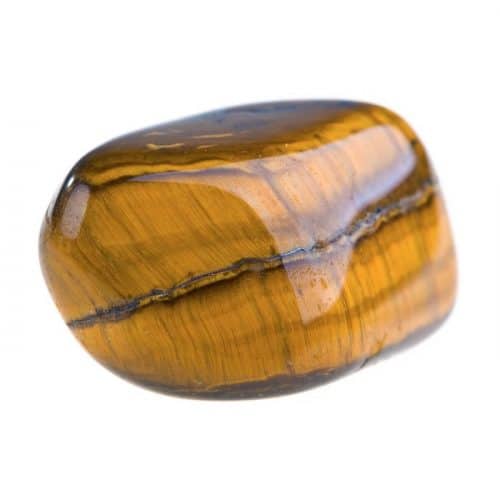 Select options This product has multiple variants. The options may be chosen on the product pageQuick View
 -

-



Mineralogical characteristics
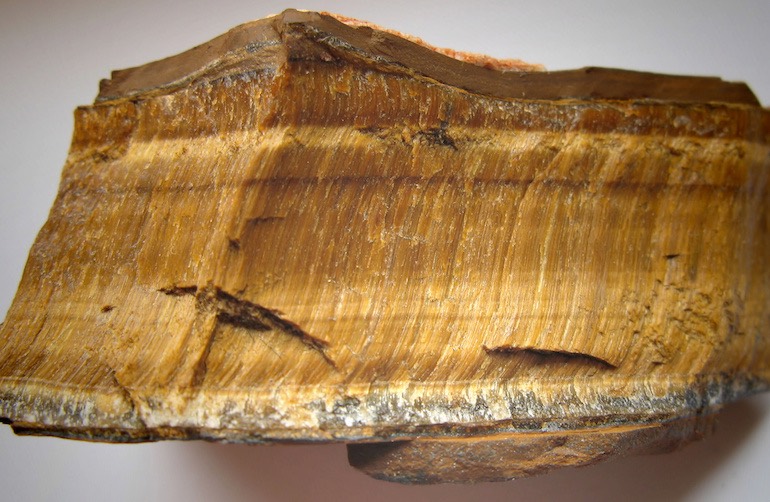
Belonging to the great quartz family, in the silicate–tectosilicate group, tiger’s eye is a macro-crystalline quartz (the crystals are visible to the naked eye). Its habit is described as “fibrous”. Its hardness is that of the other quartzes: about 7 on a scale of 10. Its transparency (that is, the way light passes through the mineral) is translucent or opaque.
The fibrous structure of tiger’s eye is explained by the presence of crocidolite filaments (blue asbestos) altered into iron oxide and gradually replaced by silica crystals. The breakdown of the crocidolite leaves iron oxide residues and produces the brown/yellow tones characteristic of tiger’s eye.
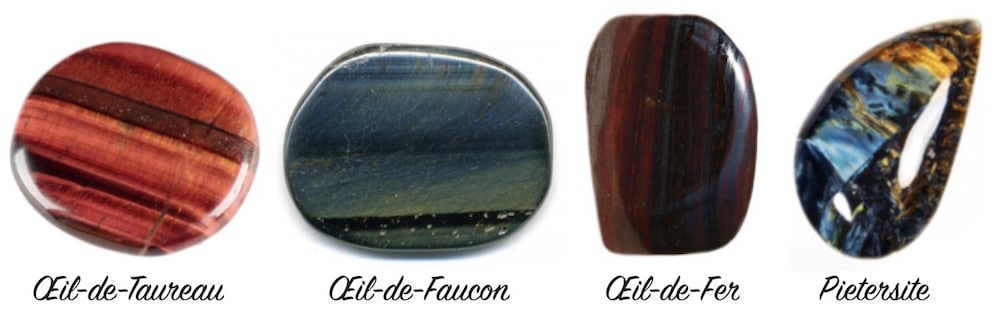
Tiger’s eye with dark red colours is called bull’s-eye. This variety is most often obtained artificially by heating tiger’s eye, whose colours change from 150° onwards.
Hawk’s-eye (or eagle’s-eye) is a mineral very similar to tiger’s eye but bluish or greenish in colour. It is generally accepted that hawk’s-eye is the result of the stage preceding that of the formation into tiger’s eye. The silica replaces the crocidolite, but there is not yet any alteration into iron oxide. Its hue is thought to be that of the original asbestos.
One can sometimes observe the simultaneous presence of tiger’s eye and hawk’s-eye in the same slabs a few centimetres in size. Curious coloured waves in brown, gold, black and blue-green are then seen, characteristic of these two species.
The mineral called iron-eye has a different origin. It is a mixture of tiger’s eye with a quartz of another species: jasper.
All these minerals are sometimes found in the same stone: tiger’s eye, hawk’s-eye, jasper and sometimes chalcedony. This astonishing rarity, pietersite, comes from Namibia.

Origin
Tiger’s eye most often comes from South Africa, from the deposits of Griqua-Town near the Kalahari. The other extraction sites are found mainly in the following countries: Australia, Namibia, Burma, China, India, Brazil and the U.S.A. (Arizona, California, Montana).
Chatoyancy (cat’s-eye effect)
The very domed cabochon cut reveals a particular effect visible on a few rare minerals: the appearance of a vertical band of light evoking a cat’s pupil.
Nowadays, the name “cat’s-eye” is reserved exclusively for another very precious mineral, of a different nature, which clearly displays this feature: chrysoberyl. This does not prevent tiger’s eye from also possessing this luminous reflection, even more spectacular in the dark colours, called “chatoyancy”.
Etymology and meaning of the name “tiger’s eye”
 It would seem that tiger’s eye (from the Latin oculus, eye, and tigris, tiger) has had other names, but identifying them proves tricky.
“Eyed” stones, so named in the past for their obvious resemblance to an eye, are apparently numerous in ancient Western times. Besides the famous cat’s-eye, we find: the goat’s-eye, the pig’s-eye, the snake’s-eye, the fish’s-eye, the wolf’s-eye and even the crayfish’s-eye!
Tiger’s eye does not appear in this curious bestiary, but we note that these names given by the European mineralogists of old refer to animals known to all and frequently encountered; wolves were then seen in our countryside, but not tigers!
The name “tiger’s eye” perhaps comes from Eastern countries, or else it became established later on to distinguish it from cat’s-eye – chrysoberyl.
Tiger’s eye throughout history
In the ancient world
The remarks about the origin of its name raise a question: was tiger’s eye known and used before the beginning of the 19th century? Eastern and African civilisations certainly knew of scattered local deposits. In Europe, the Romans worked the Cornwall mines at Cape Lizard in England, where tiger’s eyes were discovered.
The “chatoyant quartzes” were particularly fascinating, and their use as protective talismans and amulets seems likely. In Antiquity, no exact description corresponding to tiger’s eye is found, but a few connections are possible, provided one does not forget the warning of Pliny the Elder: “It would be well to warn the reader that, according to the varied number of spots and irregularities, according to the different authors and the different shades of the veining, the names have often changed for a substance that remained the same most of the time.“
He thus describes the wolf’s-eye (which often passes for the ancient tiger’s eye): “The wolf’s-eye stone, from its Greek name: lycophthalmos, has four shades of reddish-brown, surrounded by a white circle like the eye of wolves, which it completely resembles.“
The beli-oculus is even closer to tiger’s eye; Pliny did not see it but knew of it by hearsay: “Beli-oculus was whitish with a black spot in the shape of an eye and, through the reflection of light, displayed a golden colour. The Assyrians gave it the fine name of eye-of-Belus and had consecrated it to that God”. There is also mention of an achates (agate) that resembles the skin of the lion and of stones called hyenis, “said to come from the eye of hyenas”.
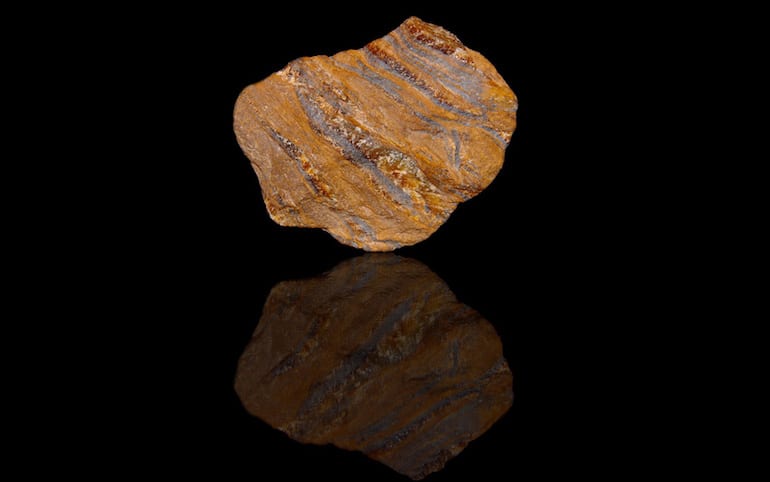
Like the Eye of Ra in ancient Egypt, eyed stones see everything, the present and the future, by day as by night. This theme is found in the very ancient alphabet of the Celts and Scandinavians that became a magical divinatory system: the runes. The 23rd sign or letter, called dagaz, is dedicated to the balance between night and day, dawn and light. Its associated stones are the sunstone and tiger’s eye.
From the Middle Ages to the contemporary world
The subtle art of the lapidaries truly flourished in the 14th century. Before that, a rudimentary cut and polish did not allow the beauty of cat’s-eyes to be fully appreciated. This would explain the rarity of tiger’s eye in ancient jewellery and decorative arts.
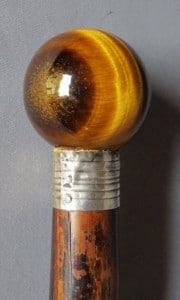 In Japan, tiger’s eye is traditionally used as a mineral pigment in the art of painting, just like jasper, agate and malachite. These pigments are known by the name Iwa enogu, and tiger’s eye is then called teishicha.
Present-day museums and auction rooms frequently exhibit tiger’s eye objects from the East or the West dating from the 17th and 18th centuries. These are most often figurines, but one can also admire cups, snuffboxes, flask stoppers, incense burners, and so on.
At the beginning of the 19th century, tiger’s eye was rediscovered. Coming from South Africa, it was at first regarded as a precious stone, then, as intense mining progressed, it was downgraded to a semi-precious stone. Its use became far more frequent in jewellery, ornamental objects and accessories; the height of exotic chic at that time was the bamboo walking stick with a tiger’s eye pommel!
The most highly prized variety of tiger’s eye today comes from Mamba-Marra in the Pilbara region of Australia. This splendid mineral with very vivid colours is considered the king of tiger’s eyes.
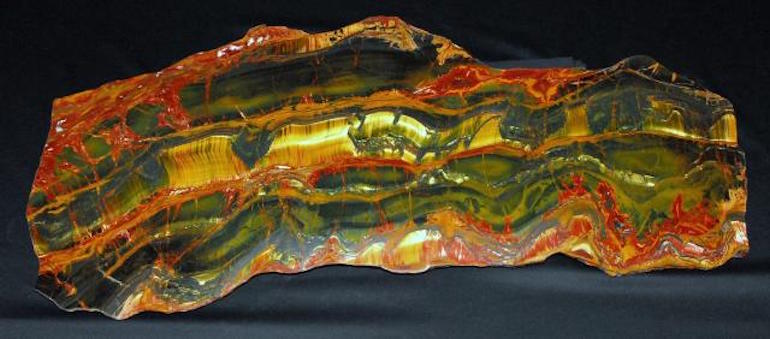
In 2005, a miner discovered the largest of the specimens ever found. First exhibited at the gem and mineral show in Tucson, Arizona, it was then cut into slices. It can now be admired on the reception counter of a luxury hotel in Port Hedland and at the museum of Kalgoorlie, a famous mining town in Australia, where it forms an impressive table top.
The virtues of tiger’s eye in lithotherapy
Tiger’s eye represents a protective shield keeping threats and dangers of all kinds at bay. By turning negative waves back towards their sender, tiger’s eye protects against the evil eye and restores courage and energy. It erases harmful intentions and the fears of the night, helping the mind to regain clarity and serenity.
The benefits of tiger’s eye against physical ailments
- Relieves joint pain (osteoarthritis, rheumatism)
- Loosens the knees and makes walking easier
- Speeds up the healing of fractures
- Improves reflexes
- Encourages the practice of all sports
- Activates the digestive functions, more especially the biliary function
- Curbs the action of harmful bacteria
- Helps to combat haemorrhoids
- Protects the endocrine glands (the adrenal glands in particular)
- Regulates the nervous system
- Soothes abdominal pain caused by stress
- Maintains visual acuity (especially at night)
The benefits of tiger’s eye on the mind and relationships
- Helps to steady concentration
- Aids meditation
- Eases fears
- Restores self-confidence
- Helps to overcome shyness
- Activates willpower and vitality
- Encourages introspection (difficult memories may sometimes resurface)
- Brings discernment and intuition
- Stimulates the sense of observation and the understanding of things
- Improves willpower and perseverance
- Releases emotional blockages
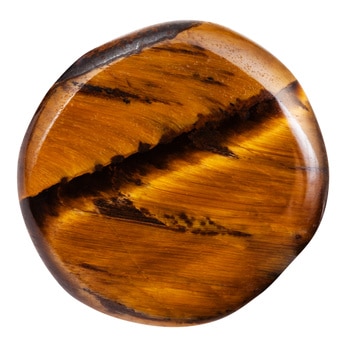 If you work with your chakras, note that tiger’s eye is associated with several chakras: the root chakra, the solar plexus chakra, and the third eye chakra.
To energise the atmosphere and benefit from its protective virtues in all circumstances, place a large tiger’s eye stone in the entrance of your home. A smaller stone will be perfect for the car and other means of transport.
Let us reassure those who might worry about the composition of tiger’s eye. The potentially dangerous asbestos fibres are completely replaced by quartz and iron oxides, so you can handle it without fear. In hawk’s-eye, the fibres are fully integrated. There is therefore no danger there either.
Cleansing and recharging
Tiger’s eye, like all quartzes, will need to be cleaned and cleansed regularly. Avoid all chemical products. Place your lithotherapy stone in a glass or earthenware container filled with distilled or salted water for at least three hours. You can also leave it under running tap water for 10 minutes.
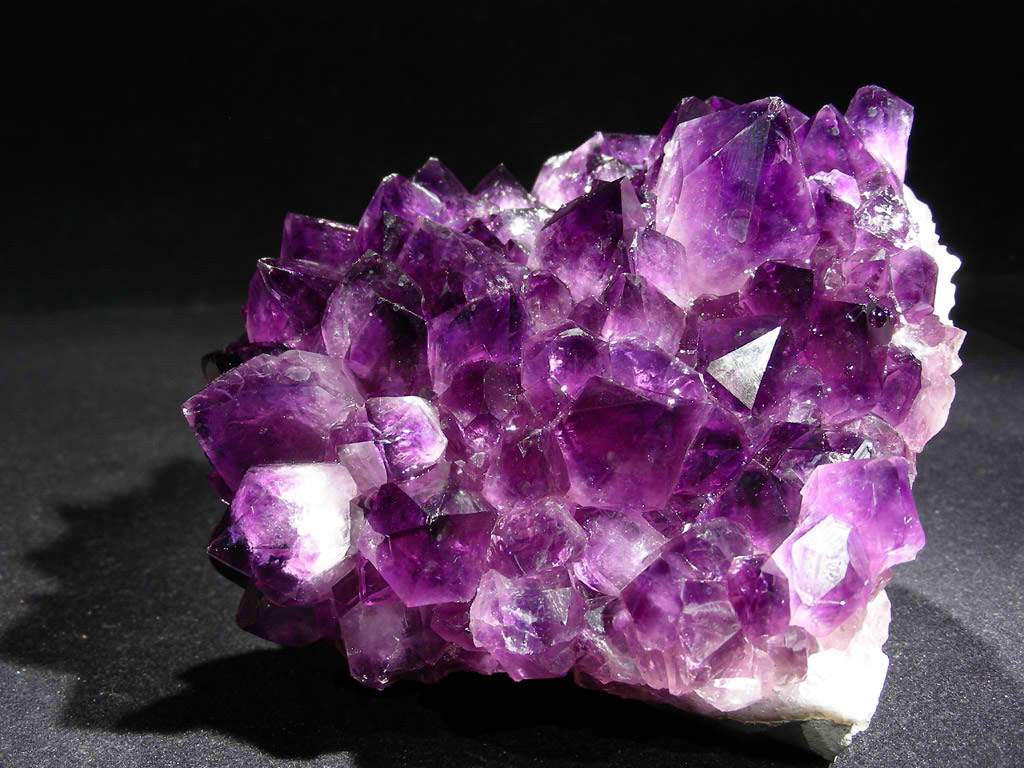
Recharging is done inside an amethyst geode, or you can expose it for a few hours to natural light: morning sun, moon rays. Tiger’s eye is sensitive to heat and to acids.
Do you love tiger’s eye, for its aesthetic appearance or for the benefits it brings you within your lithotherapy practice? Feel free to share your experience by leaving a comment below!






Leave a Reply