 English
  Français
 Español

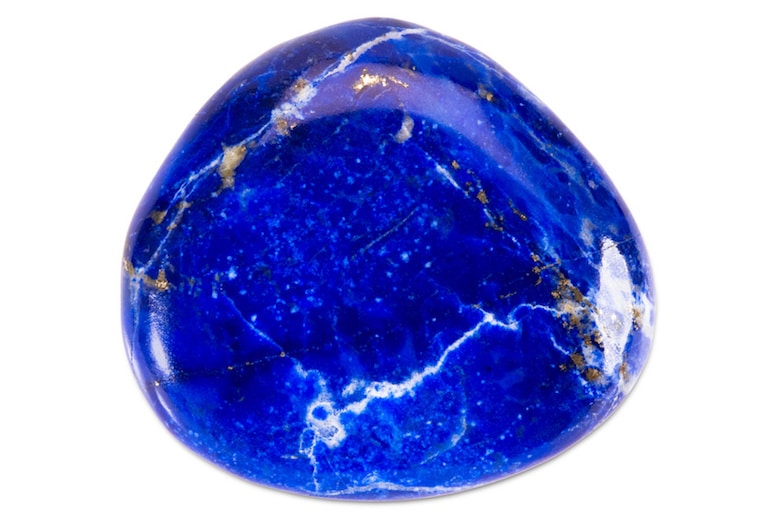
Mined and used for 7,000 years, lapis lazuli is one of the most prized rocks, in mineralogy, jewellery and lithotherapy alike. Its age-old history is fascinating, and its many powers and virtues make it a stone of a thousand and one riches. In this new article, let’s set off to discover the beautiful “azure stone”…
Lapis lazuli jewellery and objects
-
-
 Select options This product has multiple variants. The options may be chosen on the product pageQuick View
 -

-
Out of stock
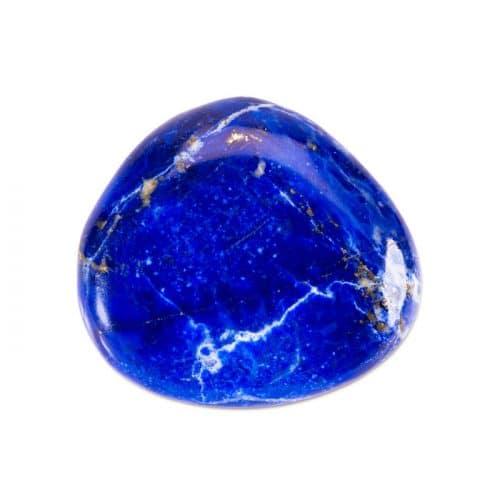 Select options This product has multiple variants. The options may be chosen on the product pageQuick ViewLapis Lazuli, Pierres Roulées
Lapis Lazuli de Qualité Extra – Pierre Roulée
Price range: 7,00€ through 44,00€ -

Mineralogical properties
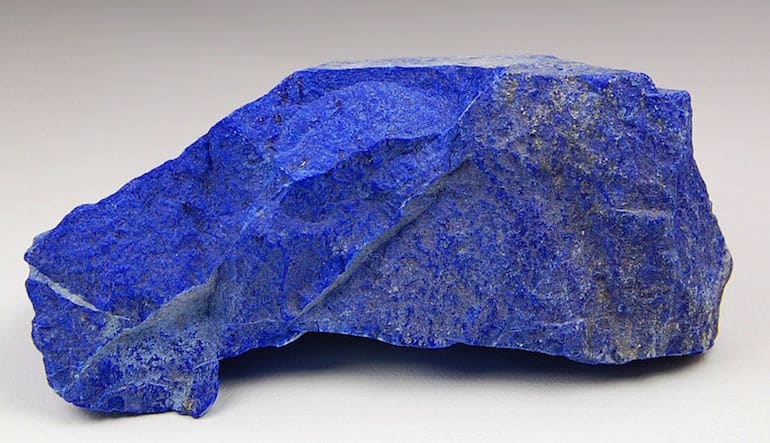
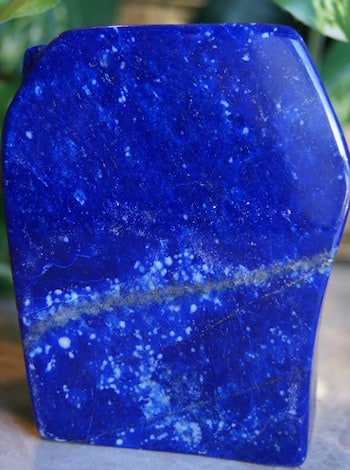
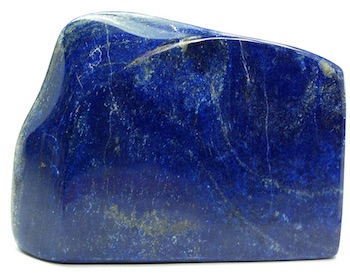
Lapis lazuli is a metamorphic rock of highly variable composition that most often forms within limestone. It is mainly composed of lazurite (from 25 to 40%), which gives it its deep blue colour, somewhere between azure and ultramarine.
Lapis lazuli is typically dotted with veins of pyrite, which have sometimes been mistaken for gold dust. Other minerals may enter into its composition, first and foremost calcite and sodalite, but also augite, mica and haüynite.
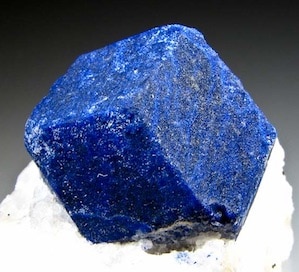 The lazurite present in the stone displays cubic symmetry. This form of cubic dodecahedral crystals can reach up to 5 cm in diameter, but pure, geometrically shaped specimens (like the one in the photo alongside) remain very rare.
Although it looks like a hard stone, lapis lazuli has a relatively low hardness of 5.5 to 6. It is found to have perfect cleavage as well as a refractive index of 1.5. Varying according to its pyrite-powder content, the stone has a density ranging from 2.7 to 2.9.
Lapis lazuli is an opaque stone with a matte lustre, which derives its value from the intensity and dominance of its blue colour. The more white calcite veins or pyrite flecks it contains, the less valuable it is.
The rarest and most beautiful lapis is found in Afghanistan, particularly in Badakhshan province, where the stone has been mined for thousands of years. Lower-value lapis generally comes from Russia, from the Lake Baikal region and Siberia. The deposits in Chile, located at Ovalle, yield a paler variety of the stone (note in passing that lapis lazuli is the country’s “national stone”).
Etymology and meaning of the word “lapis lazuli”
The name of the stone is made up of the Latin words “lapis” (meaning “stone”) and “lazuli” (meaning “of azure”). The term lazuli comes from the Persian lâdjaward, itself derived from the Sanskrit “raja farta“, which means “king’s portion” (and which indicates the almost sacred value attributed to this mineral). The Persian term became lazul in Arabic, then lazulum in Latin. Literally, lapis lazuli is therefore “the azure stone”.
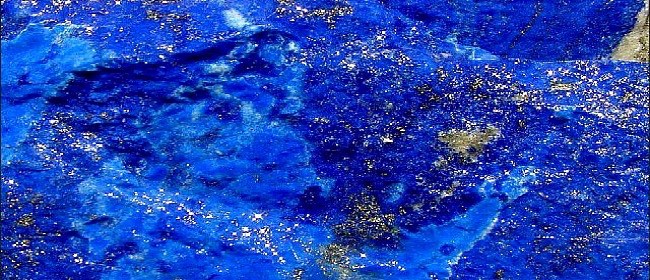
But the stone has borne various names over the millennia. In Antiquity, it was not uncommon for it to be confused with another blue stone: the sapphire. This was the case, for example, with Pliny the Elder, a Roman author of the 1st century, but also with Theophrastus in the 3rd century BC and Georgius Agricola in the 15th century. They described the stone as a sapphire with golden spots, which reminded them of a sky studded with stars.
When it was introduced into Europe, from the 5th century AD onwards, it was also referred to by the name ultramarinum. This Latin term, which translates as “ultramarine” (beyond the sea), then referred to the distant origin of the mineral, from beyond the seas. It is this name that was given to the pigment (used in painting) made from lapis lazuli.
Lapis lazuli in history
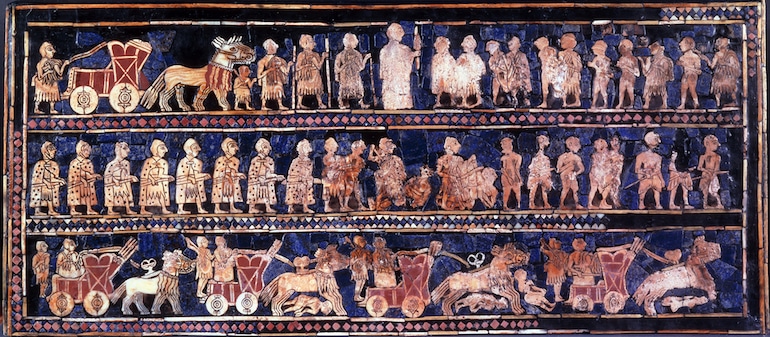
A multitude of archaeological sites point to a very ancient use of lapis lazuli. This goes back at least as far as the Neolithic (7th millennium BC). It is found in the form of beads, pendants, daggers, ornaments and amulets. It was clearly the object of a vast trade network, between Afghanistan, the Indus Valley, Mesopotamia and Egypt.
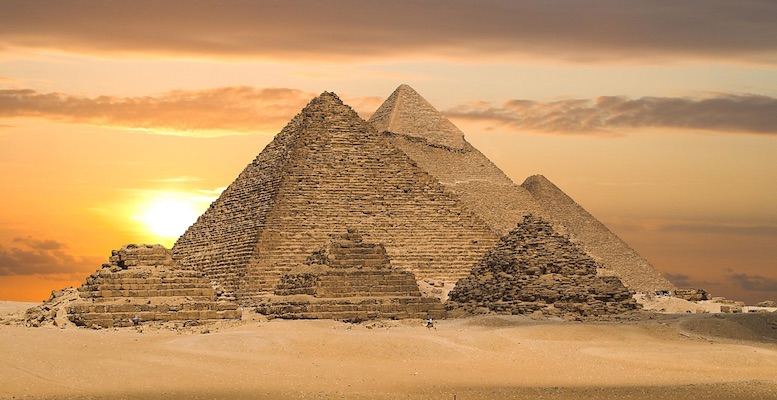
For the ancient civilisations of the Near East and Egypt, lapis lazuli was the true precious stone, more prized than gold itself. Although it is today relegated to the rank of semi-precious stone, it is no exaggeration to say, following Michèle Casanova, that the place it then occupied is that of the diamond in modern societies.
Lapis lazuli reached the peak of its symbolic and physical value during the Bronze Age, in the middle of the 3rd millennium. The Sumerians called it “the stone of stones” and located the palace of their “Great Goddess” beneath a mountain of lapis lazuli. Its ultramarine blue scattered with golden stars evokes the celestial vault and its supernatural powers. Superb lapis lazuli artefacts dating from this era are found, notably in the tombs of the Royal Cemetery of Ur in Iraq, at Mari and in the Royal Palace of Ebla in Syria. It is the stone of elites, of princes and of gods.
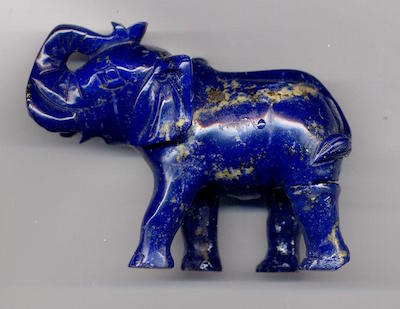
It was then used to create a multitude of lavish objects (animal statuettes, seals, amulets, etc.) and was credited with powerful virtues. It was said to be able to repel the forces of evil and it symbolised perfection. It is within this context that, in the 3rd and 2nd millennia, the idea spread across the Near East and Egypt that “to possess a fragment of lapis lazuli is to possess a fragment of the divine.“
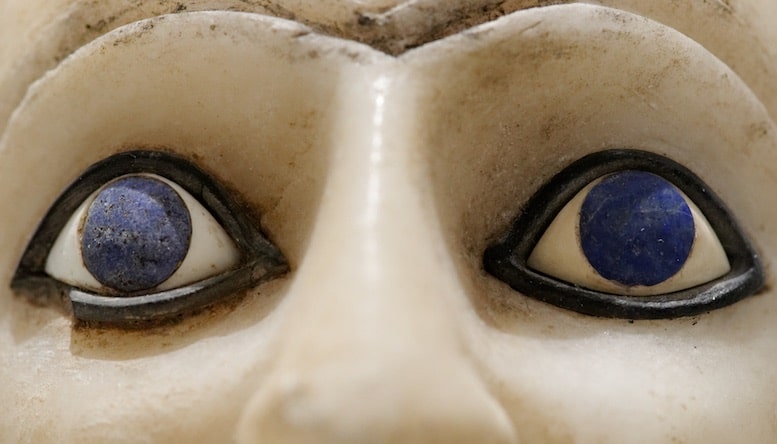
Lapis lazuli is thereby the symbol of power, both spiritual and political. It is at once the “stone of the gods”, in particular of the Egyptian goddess Isis, and the “stone of the Pharaohs”. The latter shaped it in a thousand ways (amulets, scarabs, ornaments, etc.) and used it, among other things, to make the eyes of their statues and statuettes. The Louvre Museum in Paris, for example, displays the statue of Ebih-Il, whose pupils were inlaid with lapis lazuli. The funerary mask of Tutankhamun is also inlaid with lapis lazuli, at the level of the eyebrows.
In Greco-Roman Antiquity, lapis lazuli did not hold a truly notable place. The Romans credited it with aphrodisiac virtues, and used it as an antidote to snake bites. Alongside this, it was ground up and used as a cosmetic. It is this use of the stone that would in fact develop later on, in medieval Europe.
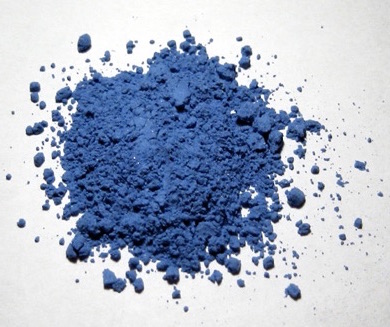 From 1400 onwards, lapis lazuli was indeed used mainly to make a pigment employed in painting: ultramarine blue. It is this pigment that would be used, for example, to paint the sky of the Sistine Chapel in Rome.
It was extremely expensive but would remain in common use among painters until the 19th century, from which point it was replaced by a synthetic pigment.
Still available today, the prices of this natural ultramarine or “genuine ultramarine” can reach €20,000 per kilo, depending on its quality and its origin.
Use of lapis lazuli in lithotherapy
Crystallised lapis lazuli is a very powerful stone, but it remains fairly rare and consequently relatively expensive. For the best results, favour a stone with a deep ultramarine blue colour and pyrite flecks over a paler one with white veins.
Virtues of lapis lazuli against physical ailments
On the physical level, lapis lazuli is a stone of balance, soothing, regulation and repair. In the Middle Ages, the stone was renowned for its rejuvenating action on the body. It was said to help maintain healthy limbs.
It is a stone that is beneficial on many levels. It helps with different types of vision disorders by improving the proper functioning of the eyes and acts particularly on night vision. Its energetic action helps to combat certain allergies. It is also recommended to bring down a fever.
It is very effective in treating the kidneys, as it regulates the water level in the body. Its medicinal properties manifest notably at the level of the bladder, the digestive system, the mouth and the stomach. It calms vomiting, relieves painful menstruation and maintains the endocrine glands. But that is not all…
Skin conditions
Lapis lazuli is particularly recommended in the event of an insect bite or a skin rash. The soothing effect of its cool blue helps to reduce pain and aids in resolving inflammation. It is also advised in the case of a burn. You can use it to massage and relieve the affected area. Generally speaking, it strengthens the skin and helps to fight diseases affecting this organ (allergies, eczema, etc.).
Hair and nails
 It is from the base chakra (or root chakra) that lapis lazuli works on accelerating hair regrowth and that of the nails. It also helps to resolve dandruff problems and allows for beautiful hair. You can use a lapis lazuli elixir for this purpose.
Throat and respiratory system
Placed at the level of the throat chakra, lapis lazuli is particularly beneficial to this region of the body. It plays a role in strengthening the lungs, fortifies the throat, activates the functioning of the thymus and provides help with diseases of the pharynx.
The stone is known to stop coughing and sneezing. It resolves in particular inflammation of the tonsils and of the area located between the throat and the upper part of the lungs (the bronchi, the pharynx, etc.). It is a stone recommended for asthmatics.
Arterial hypertension
Lapis lazuli fortifies and regulates blood pressure. It is beneficial for people suffering from arterial hypertension. It is, however, anything but an asset for those who have low blood pressure. The latter are advised not to wear the stone, nor to keep it in their bedrooms while they sleep.
Migraines and headaches
Lapis lazuli is renowned for its ability to soothe headaches. You can make use of its curative action by taking a pebble and applying it to the painful areas of the head or the neck. To prevent the reappearance of a migraine, sleep with a lapis lazuli stone under your pillow for a few days.
Hearing and tinnitus
Lapis lazuli is recommended as a stone beneficial to the auditory system. It helps in cases of hearing loss. For people suffering from tinnitus, it is advised to massage the area of the ears with a lapis lazuli, with the aim of reducing the volume and intensity of the whistling or phantom sounds.
Psychic and psychological virtues of lapis lazuli
On the psychological and spiritual level, lapis lazuli elevates the soul and stabilises the mind. It is a stone that brings wisdom, self-confidence, intuition and creative expression. It aids introspection, inner discipline and allows one to be at once more vigorous, more focused and more serene.
A symbol of protection, lapis lazuli helps one get through difficult moments and situations. It is able to revive the courage of its owner, to free them from their anxieties and to relieve their stress. Lapis lazuli extinguishes anger, brings peace and serenity, and enables one to face the truth with objectivity and clarity.
 Spiritual elevation and creative expression
The appearance of lapis physically reveals its celestial power. It allows us to merge into the starry vault so as to better understand our position in the universe. The stone thereby plays a role in improving keenness of mind and the stimulation of creative expression. Being an excellent diagnostician of deficiency, it also helps in correcting weaknesses on the psychic and psychological levels.
Courage and self-confidence
Lapis stone is the most suited to shy people, introverts and those who are withdrawn, because it enhances self-confidence through acceptance of one’s own self. Being the symbol of a strong personality and of hope, it gives courage to people wishing to move forward and surpass their limits. It also shapes humour and quick wit. It is the ideal stone in every field concerning communication.
Dream memory and lucid dreams
Lapis lazuli, as a stone that promotes inner vision, also facilitates dream memory, their interpretation, and the occurrence of lucid dreams.
Depression and anxiety
Lapis lazuli helps to harmonise the different planes physical, psychological, and spiritual. It prevents the imbalances that are liable to cause malaise and the onset of depressive states. It helps to overcome depression and to break free from anxiety and old fears.
Opening of the third eye
It is sometimes recommended to wear lapis lazuli as a circlet in the middle of the forehead because it opens the third eye and stimulates inner vision, intuition and the higher faculties of the mind. Lapis has the reputation of activating clairvoyance and favouring dowsing research. This is a stone able to connect the higher self to the divine guide and to facilitate meditation.

Stone of love and friendship
Known as a stone that brings good cheer, lapis lazuli improves human relationships. It brings people closer together and creates an aura of shared joy and tenderness around its owner. It helps to mend conflicts and to encourage people towards frankness and honesty. This blue stone is also renowned for its influence on fostering loyalty, as it strengthens the bonds existing between two lovers.
Cleansing and recharging lapis lazuli
 Like all healing minerals, lapis lazuli needs to be regularly cleansed and recharged to continue bringing you its benefits. Here are some tips for carrying out these steps of cleansing and recharging your “azure stones”.
Cleansing your stone allows it to rid itself of the negative energies it may have absorbed while you were using it. This accumulation can occur both when you wear the stone and when you place it on yourself during a lithotherapy session.
To cleanse your lapis lazuli and free it from this accumulated energy, immerse it in a large bowl of water and let it soak for a whole night. Plain tap water will do perfectly well, otherwise use distilled water. Make sure the container is made of a natural material, preferably glass, and not plastic. Be careful never to use either salt or salt water. This would have the effect of damaging the stone.
To recharge your stone, you can simply place your lapis in natural light. Take care, however, to avoid prolonged exposure to sunlight. Moonlight is the most recommended.
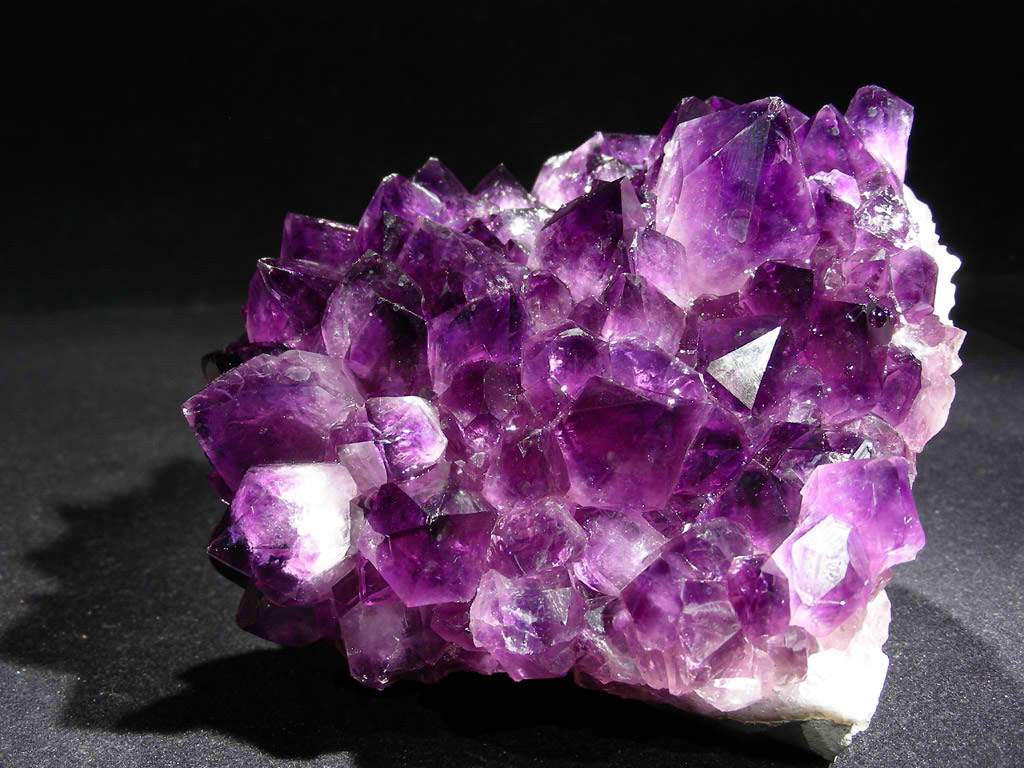
You can also recharge your lapis lazuli using a cluster of quartz. To do this, place it within an amethyst geode. This method, which is very respectful of the stone, also has the advantage of cleansing and recharging it at the same time.






Leave a Reply